


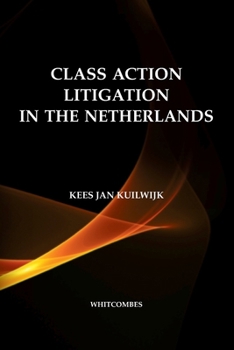
Class Action Litigation in The Netherlands
No Customer Reviews

This book explains how collective redress operates under Dutch law, with particular emphasis on the WAMCA, the statutory regime that has enabled representative organizations to pursue damages claims on behalf of large groups on an opt-out basis since 2020. Its starting point is economic. Claims too small to justify the cost of individual litigation will ordinarily never be brought. Collective actions and litigation funding are mechanisms for overcoming that problem. The question running through the book is therefore one of control: who controls a collective claim, and in whose interests is it pursued? Dutch law answers that question institutionally. Claims are brought by foundations and associations subject to judicial supervision, rather than by entrepreneurial lawyers operating as is familiar in the United States. The courts scrutinize the governance, independence and representativeness of those organizations, as well as the role, influence and economic interests of litigation funders. The book follows a collective action through the principal stages at which the legal regime confronts it, from jurisdiction, admissibility and commonality to settlement and distribution. It then turns to more difficult substantive questions: how aggregate damages can be quantified, how claims may be bundled through assignment, and how compensation for non-material harm under the GDPR is developing. Comparison with the UK and US systems leads to the book's central conclusion. The Dutch model subjects collective claims to intensive scrutiny at the outset. That scrutiny protects the interests of the represented class and seeks to ensure that claims are properly governed, adequately funded and genuinely representative. But it also postpones the redress the system was created to deliver. The emerging case law increasingly exposes the cost of that trade-off: a regime designed to make mass claims more efficient can itself become a source of delay, complexity and expense before the merits are ever reached. About the Author
Dr Kees Jan Kuilwijk is a competition lawyer with more than 30 years of experience in EU and national competition law. His practice focuses on collective redress and antitrust damages litigation, and he has acted in some of Europe's largest competition-law damages proceedings on behalf of consumers and businesses. He is an attorney at Hagens Berman Sobol Shapiro LLP. Dr Kuilwijk obtained his PhD, awarded cum laude, from the European University Institute in Florence.
Dr Kees Jan Kuilwijk is a competition lawyer with more than 30 years of experience in EU and national competition law. His practice focuses on collective redress and antitrust damages litigation, and he has acted in some of Europe's largest competition-law damages proceedings on behalf of consumers and businesses. He is an attorney at Hagens Berman Sobol Shapiro LLP. Dr Kuilwijk obtained his PhD, awarded cum laude, from the European University Institute in Florence.
Format:Paperback
Language:English
ISBN:1065444400
ISBN13:9781065444404
Release Date:October 2026
Publisher:Whitcombes
Length:536 Pages
Weight:1.56 lbs.
Dimensions:1.1" x 6.0" x 9.0"
Customer Reviews
0 rating
Copyright © 2026 Thriftbooks.com
Terms of Use | Privacy Policy | Do Not Sell/Share My Personal Information | Cookie Notice | Cookie Preferences | Accessibility Statement
ThriftBooks ® and the ThriftBooks ® logo are registered trademarks of Thrift Books Global, LLC
ThriftBooks ® and the ThriftBooks ® logo are registered trademarks of Thrift Books Global, LLC
