


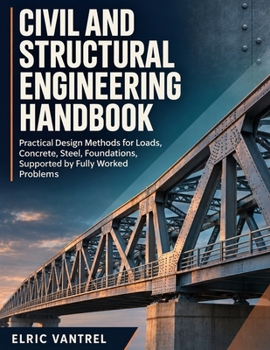
Civil and Structural Engineering Handbook: Practical Design Methods for Loads, Concrete, Steel, Foundations, Supported by Fully Worked Problems
No Customer Reviews

Understanding structural engineering takes more than memorizing equations. Can you follow a load through supporting members and into the foundation-and check whether the calculation makes engineering sense?
Structural engineering is not a collection of disconnected formulas. Loads pass through members, connections, and foundations; material behavior affects resistance and deformation; and every calculation depends on a defensible model and careful checks. The challenge for many learners is seeing how these pieces work together.
This handbook connects fundamental theory with practical design methods. It progresses from equilibrium and mechanics of materials through structural analysis, load assessment, member behavior, foundation calculations, construction coordination, and integrated building examples. Fully worked problems, practice exercises, and answer explanations help readers follow the reasoning behind each method and revisit concepts that need reinforcement.
Inside, you will explore how to: Work through load calculations, tributary areas, reactions, and internal forces in beams, trusses, and frames.Relate stress, strain, bending, shear, torsion, and deflection to structural behavior.Understand determinate and indeterminate systems, including introductory matrix-stiffness analysis.Examine wind and seismic actions, lateral stability, and serviceability checks.Study concrete and steel member checks alongside connections, anchorage, and detailing principles.Connect soil properties, bearing pressure, and settlement considerations with shallow foundations.Verify units, assumptions, equilibrium, model behavior, calculation records, and construction information.Across sixteen chapters, learning objectives, worked examples, practice exercises with answers, key terms, a glossary, unit-conversion appendices, and an index support focused study and review. Integrated building cases connect gravity framing, lateral-system assessment, foundation load transfer, and engineering reporting, showing why separate calculations must be coordinated.
Designed for civil and structural engineering students, advanced self-learners, and early-career practitioners, this is a quantitative educational reference. It is not a replacement for current governing codes, project-specific investigations, or qualified professional design review.
Add this handbook to your technical reference library and begin working through the methods, examples, and verification habits that connect structural theory with practical engineering judgment.
Format:Paperback
Language:English
ISBN:B0HQSGSY6K
ISBN13:9798140519858
Release Date:November 2026
Publisher:Independently Published
Length:514 Pages
Weight:2.60 lbs.
Dimensions:1.0" x 8.5" x 11.0"
Customer Reviews
0 rating
Copyright © 2026 Thriftbooks.com
Terms of Use | Privacy Policy | Do Not Sell/Share My Personal Information | Cookie Notice | Cookie Preferences | Accessibility Statement
ThriftBooks ® and the ThriftBooks ® logo are registered trademarks of Thrift Books Global, LLC
ThriftBooks ® and the ThriftBooks ® logo are registered trademarks of Thrift Books Global, LLC
