


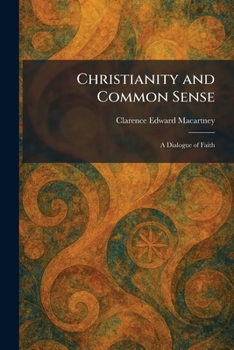
Christianity and Common Sense: A Dialogue of Faith

"Christianity and Common Sense: A Dialogue of Faith" is a thought-provoking exploration of the intellectual and practical foundations of the Christian life. Written by the influential theologian Clarence Edward Macartney, this work utilizes a conversational and accessible dialogue format to bridge the perceived gap between religious conviction and logical reasoning. Macartney addresses fundamental questions regarding the nature of God, the authority of the Bible, and the role of faith in everyday human experience.
Throughout the text, Macartney argues that true Christianity is not a flight from reality but is, in fact, deeply rooted in "common sense." By engaging with various philosophical and moral challenges, he provides a robust defense of traditional Christian doctrines while offering readers a clear and reasoned pathway to spiritual understanding. The work stands as a significant contribution to the field of Christian apologetics, reflecting the theological debates of the early twentieth century while remaining relevant to contemporary discussions on the compatibility of faith and reason.
This volume is an essential resource for those seeking to understand the rational basis of religious belief and for students of American religious history interested in the voice of a leading conservative scholar. "Christianity and Common Sense: A Dialogue of Faith" remains a testament to Macartney's skill in making complex theological concepts accessible to a broad audience.
This work has been selected by scholars as being culturally important, and is part of the knowledge base of civilization as we know it. This work was reproduced from the original artifact, and remains as true to the original work as possible. Therefore, you may see the original copyright references, library stamps (as most of these works have been housed in our most important libraries around the world), and other notations in the work.
This work is in the public domain in the United States of America, and possibly other nations. Within the United States, you may freely copy and distribute this work, as no entity (individual or corporate) has a copyright on the body of the work.
As a reproduction of a historical artifact, this work may contain missing or blurred pages, poor pictures, errant marks, etc. Scholars believe, and we concur, that this work is important enough to be preserved, reproduced, and made generally available to the public. We appreciate your support of the preservation process, and thank you for being an important part of keeping this knowledge alive and relevant.
Customer Reviews
ThriftBooks ® and the ThriftBooks ® logo are registered trademarks of Thrift Books Global, LLC
