


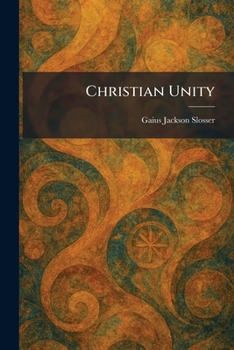
Christian Unity

"Christian Unity" is a comprehensive historical and analytical study of the movements and efforts directed toward unification within the Christian Church. Written by Gaius Jackson Slosser, this work provides a detailed survey of the ecumenical movement, tracing its development from the apostolic era through the early church councils and into the modern period. The author examines the theological, social, and structural challenges that have led to divisions within the faith, while also documenting the persistent efforts to overcome these barriers through dialogue and cooperation.
The text analyzes various historical schemes for reunion and the impact of the Reformation on ecclesiastical structures. By exploring the foundations of interdenominational relations, Slosser offers a profound look at the quest for a singular, harmonious Christian identity. "Christian Unity" stands as a significant scholarly contribution to the field of ecumenics, offering valuable insights for readers interested in church history, theology, and the institutional dynamics of religion. Its historical perspective provides a vital framework for understanding the complexities of religious integration and the enduring aspiration for collective Christian witness.
This work has been selected by scholars as being culturally important, and is part of the knowledge base of civilization as we know it. This work was reproduced from the original artifact, and remains as true to the original work as possible. Therefore, you may see the original copyright references, library stamps (as most of these works have been housed in our most important libraries around the world), and other notations in the work.
This work is in the public domain in the United States of America, and possibly other nations. Within the United States, you may freely copy and distribute this work, as no entity (individual or corporate) has a copyright on the body of the work.
As a reproduction of a historical artifact, this work may contain missing or blurred pages, poor pictures, errant marks, etc. Scholars believe, and we concur, that this work is important enough to be preserved, reproduced, and made generally available to the public. We appreciate your support of the preservation process, and thank you for being an important part of keeping this knowledge alive and relevant.
Customer Reviews
ThriftBooks ® and the ThriftBooks ® logo are registered trademarks of Thrift Books Global, LLC
