


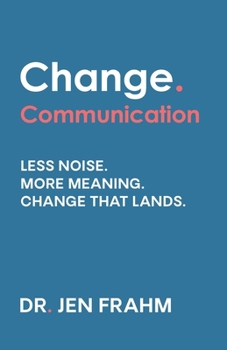
Change. Communication: Less noise. More meaning. Change that lands

Change communication has a volume problem. When people don't understand a change, the instinct is to send more - another all-staff email, another town hall, another FAQ. And still people feel confused, cynical, or checked out.
The issue was never volume. It's that broadcasting is only one of the three jobs change communication has to do.
In Change.Communication, Dr Jen Frahm sets out the framework at the heart of two decades of practice and doctoral research: change communication does three distinct jobs - monologic (creating stability through clarity), dialogic (creating momentum through conversation and co-creation), and sensemaking (helping people work out what it all actually means). The craft lies in knowing how to sequence and move between them.
Structured around the past, present and future of the discipline, the book maps the contemporary practices that genuinely cut through - micro communications, user-generated content, brain-friendly and audience-centric design, and AI-enabled approaches - before looking ahead to a future of fragmented attention, competing narratives and accelerating technology. In that world, the practitioners who thrive won't be the ones who communicate the most, but the ones who know what to say, what to hold back, and what to protect.
Grounded in a three-round Delphi study spanning eleven experts across seven countries, this is a book for established change and communication practitioners who want more than templates. Its throughline is a reframe: communication isn't an activity you perform on top of change - it's the environment in which change either takes hold or comes undone.
Less noise. More meaning. Change that lands.
Customer Reviews
ThriftBooks ® and the ThriftBooks ® logo are registered trademarks of Thrift Books Global, LLC
