


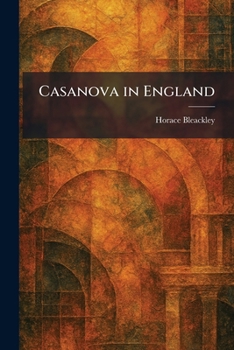
Casanova in England

Select Format
Select Condition 
Book Overview
"Casanova in England" is a compelling historical account of the legendary Giacomo Casanova's residence in London during the mid-eighteenth century. Written by the noted biographer Horace Bleackley, this work delves into a specific and often overlooked chapter of the adventurer's life, drawing upon Casanova's own memoirs supplemented by rigorous historical research.
The narrative follows Casanova as he navigates the complex social hierarchies of Georgian society, detailing his pursuit of pleasure, his recurring financial struggles, and his interactions with both the English elite and the city's vibrant underworld. Bleackley provides a vivid portrayal of London in 1763, capturing the atmosphere of the city's gambling dens, theaters, and high-society salons. Through the eyes of one of history's most famous libertines, readers gain a unique perspective on the customs, morals, and daily life of the era.
From his ill-fated infatuation with the alluring Marianne de Charpillon to his encounters with various notable figures, "Casanova in England" offers an engaging blend of biography and social history. This work remains an essential resource for those interested in the life of Casanova and the scandalous, colorful world of eighteenth-century Britain.
This work has been selected by scholars as being culturally important, and is part of the knowledge base of civilization as we know it. This work was reproduced from the original artifact, and remains as true to the original work as possible. Therefore, you may see the original copyright references, library stamps (as most of these works have been housed in our most important libraries around the world), and other notations in the work.
This work is in the public domain in the United States of America, and possibly other nations. Within the United States, you may freely copy and distribute this work, as no entity (individual or corporate) has a copyright on the body of the work.
As a reproduction of a historical artifact, this work may contain missing or blurred pages, poor pictures, errant marks, etc. Scholars believe, and we concur, that this work is important enough to be preserved, reproduced, and made generally available to the public. We appreciate your support of the preservation process, and thank you for being an important part of keeping this knowledge alive and relevant.
Customer Reviews
ThriftBooks ® and the ThriftBooks ® logo are registered trademarks of Thrift Books Global, LLC
