


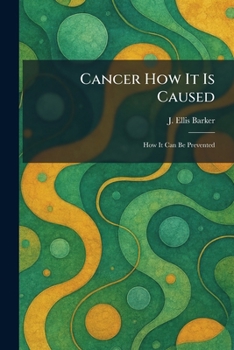
Cancer How It Is Caused: How It Can Be Prevented

"Cancer How It Is Caused: How It Can Be Prevented" is a pioneering study from the early 20th century that delves into the environmental and lifestyle factors contributing to one of humanity's most persistent health challenges. Written by J. Ellis Barker, this work presents a compelling argument that cancer is largely a preventable disease linked to the advancements and dietary shifts of modern civilization.
Throughout the text, Barker examines the correlation between chronic illness, the consumption of processed foods, and the onset of malignant growths. By advocating for a return to simpler, whole-food diets and improved hygiene, the author seeks to provide readers with actionable insights into safeguarding their health. The book compiles observations from various medical practitioners and researchers of the era, offering a comprehensive overview of the theories surrounding carcinogenesis during the 1920s.
As a notable contribution to the history of preventative medicine, "Cancer How It Is Caused: How It Can Be Prevented" remains a valuable resource for those interested in the historical development of oncology and the long-standing discourse on the relationship between diet and disease.
This work has been selected by scholars as being culturally important, and is part of the knowledge base of civilization as we know it. This work was reproduced from the original artifact, and remains as true to the original work as possible. Therefore, you may see the original copyright references, library stamps (as most of these works have been housed in our most important libraries around the world), and other notations in the work.
This work is in the public domain in the United States of America, and possibly other nations. Within the United States, you may freely copy and distribute this work, as no entity (individual or corporate) has a copyright on the body of the work.
As a reproduction of a historical artifact, this work may contain missing or blurred pages, poor pictures, errant marks, etc. Scholars believe, and we concur, that this work is important enough to be preserved, reproduced, and made generally available to the public. We appreciate your support of the preservation process, and thank you for being an important part of keeping this knowledge alive and relevant.
Customer Reviews
ThriftBooks ® and the ThriftBooks ® logo are registered trademarks of Thrift Books Global, LLC
