


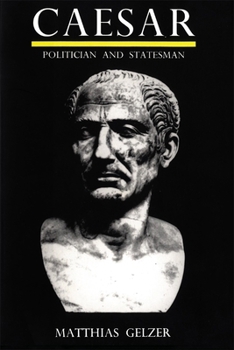
Caesar: Politician and Statesman

Select Format
Select Condition 
Book Overview
In 1912 a young scholar published a slim volume investigating the social structure of the late Roman Republic, which was in due course to transform the study of Roman history. The author, Mattias Gelzer, went on to hold the Chair of Ancient History at Frankfurt and to become the greatest German-speaking historian of the Roman Republic since Mommsen. In 1921 he published his Caesar, which has by now gone through six editions in Germany and is still the standard account, in any language, of Caesar and his age. It amply fulfills the author's intent "to give the educated public a lively picture of the complete political career of one of the great statesmen of the past."
Based on a conscientious evaluation of the abundant source materials--primarily the writings of Caesar and his contemporaries--Professor Gelzer's portrait renders Caesar in heroic proportions, destined and determined from the beginning to overthrow a corrupt aristocracy. The sixth edition (1960), brought up to date and provided with full annotations by the author, is the basis of this translation, which for the first time makes the work available in English. With Professor Gelzer's approval, some minor errors have been corrected, both in the text and in the chronological table and the map at the end of the book, and an analytical index of names has been added.Format:Paperback
Language:English
ISBN:0674090012
ISBN13:9780674090019
Release Date:January 1968
Publisher:Harvard University Press
Length:368 Pages
Weight:1.10 lbs.
Dimensions:0.8" x 6.1" x 9.0"
Customer Reviews
5 ratings
Definitive Biography On Julius Caesar
Published by Thriftbooks.com User , 18 years ago
I read this book for a graduate course in Roman history. Pompey's apex of power and glory was in 61 BCE, when he returned to Rome to receive his third triumph after his victories in the Middle East, brought new territory and treasure to Rome. With his sterling military reputation and great personal wealth, one would have thought that Pompey could dictate terms to the senate. However, Marcus Porcius Cato 95-46 BCE and his optimate party associates in the Senate, fearful of Pompey's power and ambition and wanting to protect their own political oligarchy, were successful in keeping political power out of his hands. Not only did Cato force Pompey to disband his legions as a condition of his receiving his triumph in Rome, he also embarrassed Pompey by insuring that the Senate did not make any land grants to Pompey's veterans. These actions weakened Pompey's political strength. It kept him from giving out positions of patronage to his supporters and it also lost him favor in the eyes of his veterans. As a result, it also had the effect of making him look like a political weakling when he would later try to stop the ambitious Julius Caesar. Once again, Plutarch observed that although Pompey may have been a great military general, he was no match for others as a political leader. "And well had it been for him had he terminated his life at this date, while he still enjoyed Alexander's fortune, since all his aftertime served only either to bring him prosperity that made him odious, or calamities too great to be retrieved." While Cato and the Senate were going out of their way to quench Pompey's fiery ambitions, Julius Caesar started to make his grab for power over Rome. Matthias Gelzer's biography of Julius Caesar is an excellent in-depth analysis of Caesar's life. Caesar hailed from one of the minor and less politically active patrician families. Although a senator's son, Caesar's standing in society was first improved by the fact that Marius became his uncle by marriage. Secondly, to further his own political career he married Cornelia, the daughter of the Roman consul Cinna. In 80 BCE Julius Caesar embarked on a military career and made his mark quickly as an able military commander. Gelzer observed that early in Caesar's life he already mastered "how to exploit his talents to the full...he was already a respected orator and, a dashing officer that had shown bravery." Gelzer pointed out that there were two dominant political parties in Rome at the time. The optimates were dominated by the conservatives who worked to protect the prestige of the senate, the rich, and the status quo of Rome. The populares party that Caesar belonged to, played to the lower class multitudes of Rome in deed and word. By 59 BCE Caesar had made several moves in his life which furthered his political career and gained him his first consulship of Rome. Caesar worked hard at getting the two most powerful men in Rome, Pompey and Marcus Licinius Crassus 115-5
Fascinating.... Republic scholars must read!
Published by Thriftbooks.com User , 22 years ago
If you are interested in the final years of the Roman Republic or Julius Caesar, this book is for you. I first read Anthony Everitt's Cicero (which I liked) and it's brief discussions of Caesar were enough to pique my interest in further study of Caesar. After researching a bit, Gelzer's biography seemed to be the most lauded- and having read it- rightly so. The level of detail in this book is incredible. There are hundreds of footnotes indicating sources and often containing quotes in their original language which is as often Greek as it is Latin. Gelzer really shows us the genius and abilities of this most fascinating man- perhaps the boldest, most brilliant military commander in history- not to mention an equally talented politician! Caesar deserves our attention. If you can handle great detail and really want to know Caesar and his times, you will like this book.
The classic biography of Caesar
Published by Thriftbooks.com User , 22 years ago
In writing a Web biography of Julius Caesar, I read dozens of books trying to explain this chameleon man, probably the most famous Roman who ever lived. And after it all, I came back to this as my firm choice as THE book to read if you want a comprehensive, scholarly, yet still fascinating excavation of everything we truly know about Caesar. Gelzer's book is a classic on everyone's list. First published in German in 1921, Gelzer labored and rewrote it over half a century, reading and rethinking all the time. It was finally translated into English in the 1960's. As he modestly concludes, "Much has been written about Caesar. The appearance of despotic rulers [Stalin, Hitler] of quite a different stamp has not always been favourable to the judgment passed on him. A fresh study of the sources has, on the whole, convinced me of the correctness of my interpretation." Gelzer makes those sources lucid, explaining contradictions, noting where a history is political rather than factual, smoothing out inconsistencies and providing copious notes for the reader who wants to learn more. There is a clarity and precision to his writing that is oddly restful, yet continually interesting, for which we must thank the readable translation by Peter Needham. In recent years, it has become fashionable to dismiss Caesar as a power-hungry megalomaniac, to psychoanlyze him, to portray him from every vantage point; but no one can deny his genius. Gelzer, unlike some modern biographers of Caesar, never strays from the facts; his thoughtful and precise narrative of every scintilla of truth remaining to us, takes you as close to the man as you are ever likely to get. About the true nature of Julius Caesar, every thinking reader must make up his own mind. Gelzer will give you the best tools to do so, while painting an unforgettable portrait of the failing Roman Republic.
Don't Buy This Book...
Published by Thriftbooks.com User , 23 years ago
Do not buy this book if you're looking for gossip about Caesar's [love] life or his romance with Cleopatra. You're not going to find any dirt or gossip about his private life; just a very sober,well argued and researched political biography. Along the way you'll hopefully come to appreciate just how remarkable Caesar's accomplishments were, given the obstacles he had to overcome along the way. Among the points which Gelzer makes is how completely different the ancient Roman Republic was compared to our modern ideas of a democratic republic. In fact, it was nothing more than an oligarchy where leadership changed hands among a rich,and ambitious elite. By Caesar's time this political system was on its last legs and it was inevitable that a general leading an army was going to overthrow the whole system at some point. While it's true that Octavian(Augustus)deserves credit for creating the system of government which ruled the empire he inherited,it's also true that he wouldn't have been able to do this had Caesar not paved the way before him. Add to this the fact that he was able to do just about anything better than any of his contemporaries and you begin to see why has continued to remain such a fascinating (and controversial)figure down through history.
Scholarship of the very highest order
Published by Thriftbooks.com User , 24 years ago
Gelzer produced a fantastic work with this seminal masterpiece. This is scholarship and historical analysis of the very highest order - ranks alongside Theodor Mommsen.I've read no other work that measures up to Gelzer's biography of Rome's greatest citizen. His inspirational definition of what it is to be a politician versus that of Statesmanship is forever etched in my mind. Those seeking contemporary pseudo-psychology, 'opinions and soundbites' need to look elsewhere as this is not Plutarch at his most irritating. A perfect counter-balance to the anecdotal and condensed approach of Plutarch. Definitive and unsurpassed in its authority.
Copyright © 2026 Thriftbooks.com Terms of Use
| Privacy Policy | Do Not
Sell/Share My Personal Information | Cookie Policy | Cookie Preferences | Accessibility Statement
ThriftBooks® and the ThriftBooks® logo are registered trademarks of Thrift Books Global, LLC
ThriftBooks® and the ThriftBooks® logo are registered trademarks of Thrift Books Global, LLC
