


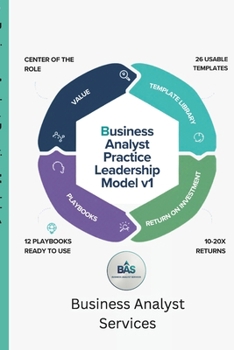
Business Analyst Practice Leadership Volume 1

What it is
Business Analyst Practice Model is the comprehensive first-volume edition of the Business Analyst Services practice methodology. It treats Business Analysis not as a delivery support function but as a discipline of enterprise capital efficiency - the way an organisation reshapes investment decisions before they are made, scales analysis to match the value at stake, and builds an institutional capability that survives staff turnover and executive change.
The book is structured in three parts, supported by twelve runnable playbooks and fifty-two artefact templates.
Part I - The Book
Three chapters set out the argument and the model:
Chapter 1 - Business Analysis as an Investment Multiplier. The economic case for repositioning BAs upstream of funding decisions, with the conditions under which a high-leverage BA returns 10-20 the cost of the role.Chapter 2 - A Practical Model for Business Analysis Delivery. The Bronze, Silver, Gold tiered model. How to choose a tier, what each tier produces, and where the calibration fails.Chapter 3 - Scaling Business Analysis Through a Centre of Excellence. What a BACOE is, what it costs by enterprise size, what it returns, when it will fail, how to build it in three phases over twenty-four months, and how to federate it for multi-billion programmes. Two composite case studies show 3.5 and 6.5 returns in practice.Part II - The Companion Playbooks
Twelve runnable playbooks turn each chapter's argument into a step-by-step process: the Business Analyst Value Generator, Project Vision Builder, As-Is/To-Be Analyser, Tier Classifier, Bronze/Silver/Gold Delivery Packs, and the five BACOE playbooks (Readiness Diagnostic, Business Case Builder, Boundary Negotiator, Operating Model Designer, Value Reporting Generator).
Part III - The Visual Library
Fifty-two artefact figures: one template and one worked example for every named deliverable in the Bronze, Silver, and Gold tiers, drawn from nine industries - banking, healthcare, higher education, insurance, logistics, government, retail, telecommunications, and utilities.
Who it is for
Executives funding or sponsoring a BA function - Part I gives the argument, the numbers, and the failure conditions in two to three hours of reading.Practice and BACOE leaders building or running the function - every chapter is paired with a runnable playbook and a worked example.Senior practitioners delivering high-leverage analysis - Part III is the reference library at their elbow.Why it's different
Most BA writing is either descriptive (here is what BAs do) or prescriptive at the artefact level (here is how to write a requirement). This book is prescriptive at the practice level - the role, the operating model, the governance, the economics, and the artefacts, designed as one coherent system. The structure aligns with the IIBA BA Role Family taxonomy and references the existing literature (Clare 2008, IIBA Career Road Map, McKinsey/Oxford project research, Flyvbjerg on megaprojects), then takes a clear position on the questions the existing literature leaves open.
Companion workshop and Volume II
A two-day intensive workshop turns the book into a working practice for a leadership cohort. Volume II - previewed at the end of the book - extends the model into operating the practice at scale: capacity planning, capability and value streams, stakeholder and team types, collaborative tooling, AI-augmented business analysis, and federated BACOE models for multi-billion programmes.
Customer Reviews
ThriftBooks ® and the ThriftBooks ® logo are registered trademarks of Thrift Books Global, LLC
