


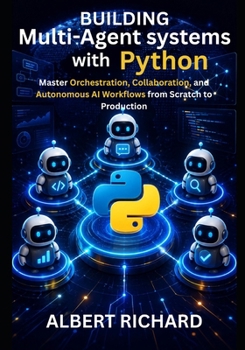
Building Multi-Agent Systems with Python: Master Orchestration, Collaboration, and Autonomous Ai Workflows from scratch to Production

Most "multi-agent" tutorials hand you a framework and hope you never need to see the wiring. This book does the opposite.
Building Multi-Agent Systems with Python shows you how to design, implement, and ship systems of collaborating AI agents-from a minimal pure-Python loop to production orchestration-so you understand every seam before you automate it. You will build real patterns: orchestrator-worker teams, parallel research waves, shared memory, tool registries, guardrails, evaluation harnesses, and end-to-end projects for content, code review, and tool-using research assistants. Modern stacks (LangGraph, CrewAI, OpenAI Agents SDK, Microsoft Agent Framework, MCP) appear as accelerators of those patterns-not as black boxes that replace them.
You gain the ability to choose the right architecture for the job, bound cost and risk, measure quality with a repeatable harness, and migrate from scratch code to frameworks without losing control. The unique promise is simple: from-scratch clarity first, production frameworks second-so when something fails at 2 a.m., you can still explain who planned, who acted, what was shared, and why the run stopped.
If you are ready to move beyond single-chat demos and build multi-agent systems you can trust, open the first chapter and start with one agent, one tool, and one hard limit-then scale on purpose.
Customer Reviews
ThriftBooks ® and the ThriftBooks ® logo are registered trademarks of Thrift Books Global, LLC
