


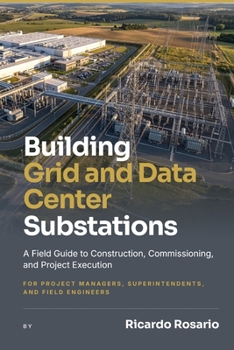
Building Grid and Data Center Substations: A Field Guide to Construction, Commissioning, and Project Execution

Built for the jobsite. Not the classroom.
Substations are being built faster than ever, for utilities, for solar and battery plants, and for data center campuses that need transmission level power on their own property. The people building them are foremen, superintendents, construction managers, project managers, and field engineers, many of them coming over from solar, storage, or general electrical work. This book is written for them.
Building Grid and Data Center Substations walks the yard in the order it gets built: civil and grading, foundations, the grounding grid, duct bank and cable trench, steel erection and bus work, setting the main power transformer, breakers, disconnects, and instrument transformers, switchgear from stick built to fully integrated eHouses, the control building, protection and SCADA, testing and commissioning, energization, and closeout.
Every chapter explains what gets built, why each requirement exists, and what the field has to check and record before the next step. It is principle based, not spec based: it names the governing standard behind a requirement so you can verify it against your own project documents, and it never asks you to trust a number out of context.
Inside you will find:
Original diagrams drawn for field use, from yard layouts to the commissioning dependency ladderQC checkpoint lists at the end of every chapterReceiving inspection checklists for every major piece of equipmentA drawing set index organized by the question you are trying to answerA field reader's guide to IEEE C37.2 device function numbersA substation glossary defined the way the field uses the termsRicardo Rosario, CCM, PMP, is a construction manager on utility-scale energy projects and the author of Building Utility-Scale BESS, a number one new release in Electrical Engineering on Amazon. This is the second book in his Field Guide series.
Customer Reviews
ThriftBooks ® and the ThriftBooks ® logo are registered trademarks of Thrift Books Global, LLC
