


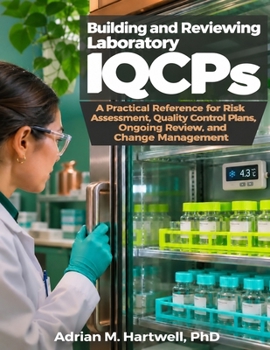
Building and Reviewing Laboratory IQCPs: A Practical Reference for Risk Assessment, Quality Control Plans, Ongoing Review, and Change Management

A detailed reference for building, implementing, and reviewing an individualized quality control plan. The book follows the reasoning behind an IQCP from the applicability decision to the evidence used in ongoing review. It addresses the actual testing process, the risks that can affect it, the controls selected, and the records needed to follow those choices over time.
Begin with the pathway and the local process. The opening chapters consider eligibility, oversight routes, and the default control procedures, then define the test system and map the work from order to report. Handoffs, locations, roles, and testing outside the main laboratory are considered alongside the difference between a generic description and what staff actually do.
Build the risk assessment from evidence. The book examines manufacturer information, guidance, local records, and other sources before controls are chosen. It describes how to record source, authority, relevance, and limits; frame an event, cause, and consequence; and work through the components of an assessment. Examples consider uncertainty and the limits of numerical risk scores.
Connect each risk to a control and a response. Preventive and detective controls are considered for what they can and cannot reveal. A risk-to-control map links the assessment to monitoring, ownership, and responses to failure. The quality control plan chapter discusses the number, type, frequency, and acceptance criteria of controls, and compares a draft plan with the assessment that supports it.
Carry the plan into daily work. Director review, approval, implementation, staff communication, access, and version control receive their own attention. Fictional cases bring the decisions into view, including a shared instrument across shifts, a storage excursion, and revised manufacturer instructions. Examples are specific to their fictional settings and are not offered as operating limits for another laboratory.
Review what happens after implementation. Chapters cover quality assessment, local measures, investigation of testing process failures, and checks on whether a corrective action holds. Change management and traceability connect revisions to the evidence that prompted them. An evidence index and review exercise help the reader follow the reasoning across records.
Put the tools to work in your own setting. Appendix A provides original blank layouts and examples, including an applicability record, workflow description, source register, process map, and risk-to-control tools. Readers may copy the blank layouts for use within their own laboratories. The examples support discussion and adaptation; the laboratory remains responsible for its own approved procedures and decisions.
For laboratory directors, quality leaders, supervisors, and staff who prepare or review plans. This educational reference supports a disciplined discussion of risk, evidence, and controls without promising an inspection or accreditation outcome. Check current federal requirements, agency guidance, accreditation and state rules, and manufacturer instructions before acting. Use the book to make the plan's reasoning visible and keep that reasoning connected to the work it governs. It also gives reviewers a way to revisit the assumptions behind a control when a process, source of evidence, or operating condition changes. The supporting records show how the local decision was reached.
Customer Reviews
ThriftBooks ® and the ThriftBooks ® logo are registered trademarks of Thrift Books Global, LLC
