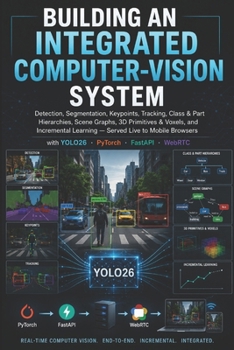
Building an Integrated Computer-Vision System: Detection, Segmentation, Keypoints, Tracking, Class & Part Hierarchies, Scene Graphs, 3D Primitives & V

Most computer-vision tutorials hand you a demo: a box drawn around a face, a label slapped on a cat, and then nothing. The moment you ask a second question - Is that car moving? What is it near? Where is it in 3D? - the demo falls silent.
This book builds a system instead of a demo. From a single camera frame, you'll produce a structured, queryable description of the entire scene - a world model you can interrogate like a small database: the same object keeps its identity across frames, its parts, its properties, its place on the ground, and its relationships to everything else.
Working in Python with today's open-source stack, you'll wire together more than a dozen capabilities into one coherent pipeline:
Detection, segmentation, keypoints, and tracking with the latest end-to-end, NMS-free YOLO26Open-vocabulary detection with YOLOE - find anything you can name, no retraining, from a 4,585-class vocabularyClass and part hierarchies, properties, states, and a queryable scene graphGround-plane estimation, geometric primitives, monocular depth, and voxel reconstruction to lift flat pixels into 3D - including a trainable 6-DoF pose headFacial recognition, OCR, and gait as second-stage, box-confined capabilitiesA two-phase cascade that stays broad at the top and sharp at the bottomA browser-based annotation studio, custom-model training, incremental and active learningA real FastAPI inference server, live video streaming, and the profiling, packaging, securing, and scaling needed to ship it
Every chapter is grounded in real, runnable open-source code, not pseudocode - with a companion repository, original diagrams, and an architecture designed so you can add a new capability or teach a new class after deployment, without forgetting what the system already knew.
Who it's for: developers, ML engineers, robotics and AR builders, and serious learners who are done running other people's demos and want to construct a perception system of their own - one frame, one world model, fully under your control.
Customer Reviews
ThriftBooks ® and the ThriftBooks ® logo are registered trademarks of Thrift Books Global, LLC