


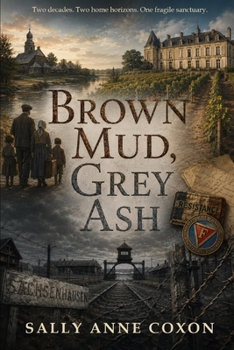
Brown Mud, Grey Ash

BROWN MUD, GREY ASH
Two centuries. Two home horizons. One fragile sanctuary.
In the 1920s, France is a land mourning its lost sons, its historic vineyards desperate for labour. In Poland, economic hardship and political upheaval leave families with little choice. Uprooting his family from the log cottages of Subcarpathia, Jan Blajda brings his family, including seven-year-old Roman, to the sun-baked ridges of Moulon in the Gironde. Here, they learn the language of the French soil, working the vines until the rich "brown mud" of the tidal stretch of the Dordogne river becomes as familiar as the earth of their ancestors. Roman grows into manhood, finding peace, purpose, and love with Simone.
But the outbreak of the Second World War shatters their hard-won sanctuary.
Drawn into the dangerous, clandestine world of the French Resistance, Roman is arrested and deported deep into the cold, industrial nightmare of the German concentration camps. There, possessed of four languages, Roman is thrust into a cruel world where his own voice is used as a weapon against his fellow prisoners-leaving a psychological scar of forced complicity far heavier than physical chains.
When liberation finally comes, Roman returns to a scarred Europe. His childhood homeland in the East has been erased by the pencil strokes of Stalin, Churchill, and Roosevelt, and now lies on Soviet territory. His only hope is the road back to the Gironde.
But the home he left behind is not the home he will find. Waiting at Chateau Montlau is his silent father, the young daughter he barely knows, and Simone-carrying the heavy secrets of her own wartime survival.
To rebuild their lives on the ridge, Roman and Simone must face each other as survivors compromised by the shadows of the past.
An atmospheric, deeply moving historical epic of exile, the unspeakable costs of survival, and the quiet resilience of the human heart.
Customer Reviews
ThriftBooks ® and the ThriftBooks ® logo are registered trademarks of Thrift Books Global, LLC
