


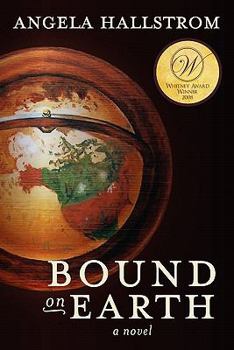
Bound on Earth

Select Format
Select Condition 
Book Overview
It is Thanksgiving Day and the Palmers have gathered to celebrate. But one person is missing: Kyle, Beth Palmer's young husband and a once integral member of this close-knit Mormon family. Kyle's... This description may be from another edition of this product.
Format:Paperback
Language:English
ISBN:0961496096
ISBN13:9780961496098
Release Date:January 2008
Publisher:Bentley Enterprises
Length:197 Pages
Weight:0.60 lbs.
Dimensions:9.0" x 0.5" x 5.8"
Customer Reviews
5 ratings
A Triumph!
Published by Thriftbooks.com User , 18 years ago
Bound on Earth is the best, most finely crafted novel featuring complex, fully-rendered Mormon characters to date. Many have tried, but Hallstrom got it right. My copy of Bound on Earth takes its place proudly next to the works of Anne Tyler and Barbara Kingsolver on my bookshelf.
Finally!
Published by Thriftbooks.com User , 18 years ago
Finally, a deeply satisfying read about real, complex characters who just happen to be Mormons. I've been waiting for this book for a long time. And, as any great work of literature, it speaks to all audiences regardless of culture. Hallstrom skillfully depicts real family dynamics through situations that make you squirm, cry, rejoice. I can't wait to give it to all my friends.
Segullah Review
Published by Thriftbooks.com User , 18 years ago
Angela Hallstrom's debut novel Bound on Earth fleshes out the fiction and non-fiction of marriage and family. Through a series of vignettes written from the perspective of different members of the Palmer family (mother, daughter, father, grandparents and others), the book allows its reader to discover the texture of being bound to those we love. It describes what happens between "I do" and our final whispers, the price of raising and losing children, the toll of mental and physical illness, and the not-so-black-and-white choice to leave or to remain. Reading the novel was like looking in a fun-house mirror. I recognized a faint double of myself but it was distorted, turned upside down, made shorter, taller, extended through time and tested. This book does what good fiction should do-distort reality just enough to tell the truth. It is difficult to find an LDS novel that adequately communicates the nuance that fills the dusty corners of our lives-that faces the reality that we must become perfect even in our imperfection. And there were moments in the novel where I thought it might easily descend into trite summaries of belief. It never did. The most powerful image of the book is found in the concept of `being bound.' At first, I felt like telling the characters to run away from their bonds, quickly and deftly, in an act of self-preservation. However, the book artfully aided my discovery that our bonds can teach us where and how to grow. It is in this imagery of `being bound' that I found my one critique. The dominance of this theme left me wanting a richer subtext of symbols to decode. I wanted more ambiguity that would keep me returning to the text. But even with this weakness, the author succeeds at articulating intimate truth and helps us uncover a maze of complicated emotions. For instance, when Beth's mother peeks through a bedroom door and sees her daughter and her daughter's husband, she comments, "They are curled towards each other, sleeping, their heads almost touching and Beth's arm slung loosely across Kyle's side. Seeing them reminds me how difficult it is for two bodies, even sleeping, to face each other and not turn away (187)." The act of facing each other, constantly resisting turning away is what this novel is about, and if that is the lesson to be learned from the book, then that is good enough for a return visit. As I discovered when I started researching genealogy, a family's story is never adequately told through a linear genealogical chart. Histories and narratives are needed for elucidation but often lead to other questions waiting to be answered. In a way, Angela Hallstrom's novel says what most genealogical documents will never say. However, maybe they should because many of these characters seem as real as the paper that I gripped when reading about them, as tangible as the warm hug that I receive from my toddler as he climbs into my bed at dark o'clock, and as vivid as the man I wake up to every morning, ever more
An Important Book
Published by Thriftbooks.com User , 18 years ago
Bound On Earth is a rarity among a lot of contemporary literature and among the sub-genre of LDS fiction. It is unlike many stories published in the annual O. Henry or Best American collections in its sense of compassion for the characters. Rather than portraying the Palmer family as a collection of freaks and walking dysfunctions as is so popular to do, the book shows the characters as flawed and difficult, humane and striving, sympathetic and, ultimately, deserving of compassion. This is not to say that each member of the family has some easy, trite, heroic moment or epiphany. On the contrary, it is their ordinariness, their familiar every-day-ness that makes them so authentic and relevant. A reader won't feel as though he or she is looking at a display behind glass in a literary museum with this book. Readers will feel as though they are visiting home, sitting next to familiar siblings, friends, and relatives at the dinner table. Rather than the cold, arm's-length distance one has come to expect from authors who seem only able to focus on dysfunction, betrayal, and emotional disaster and death, Hallstrom ably and realistically portrays real people with real struggles. She does it in a way that never insults the reader's intelligence or lets the characters off the hook. The humanity and compassion for its characters and, by extension, for its readers are what set Bound On Earth apart from most of what you can find on the New Fiction shelf these days. What sets the book apart from a lot of LDS fiction has to do with what the book is not. It isn't any of the things that are normally conjured by the label of "LDS literature." It isn't historical fiction like The Work and The Glory, it isn't weepy stuff targeted at youth like Jack Weyland's stuff, it isn't a missionary narrative. Nor is it centered around someone's struggle with faith and the climax is all about whether or not the hero stays in the church. The book is distinguished even from wonderful, classic LDS novels like The Backslider simply because it is contemporary. Hallstrom has written about Mormon life as it is right now. This isn't a reformulation of some glorious historic heritage nor is it a fossil of LDS culture from the past. These stories are finely crafted tales that both speak to and show the experience of being a Latter-Day saint in the late 20th and early 21st century. It's not intellectually popular to talk too much about emotional involvement with a book. It's okay to talk about themes, motifs, possible interpretations, extra-textual connections, etc. but it's quietly, definitely frowned upon to to just talk about how much you love a particular character or event in a story. Too much emotion is unseemly in the academic world. Emotion isn't thought, it might be said. Nevertheless, I've got to say that I loved this book and I loved these characters. I saw pieces of myself and my loved ones in them and that, I think, is a large part of why people read -- to know that we a
Levi Peterson
Published by Thriftbooks.com User , 18 years ago
"In this novel, Angela Hallstrom demonstrates an admirable mastery of the art of fiction. In essence, it is the history of an extended Mormon family. Composed of vignettes--some of which have been published as stories--the novel advances from the present into the future, retreats momentarily to the past, or works laterally to include nearly simultaneous episodes. The point of view shifts deftly among a widowed grandmother, her son and daughter-in-law, their three daughters and their husbands. The style is strong and functional, unerring in its cadence and nicely balanced between the formal and the colloquial. "The subtle background to this novel is the Mormon world view, established without preaching or assumptions of superiority. But it presents a far from idealized vision of reality. By moments the members of this extended family writhe with conflict, tension, depression, self-pity, and misbehavior. The attempts of the strong willed mother to guide and intervene often disrupt rather than heal. Her husband nearly succumbs to the veiled allurement of a seductive sister in their ward. A teen aged daughter conceives a baby out of wedlock. Another daughter is distraught by the birth of a fourth son, deeply disappointed that she has not at last borne a daughter. Yet another daughter marries--and determines to stay with--a bi-polar husband who periodically lapses into abuse. Yet ultimately their underlying bond with one another--their willingness to affirm whoever claims a place among them--triumphs. Though bound on earth, this is a family that will endure in eternity. "If there's a lesson to be learned from this novel, it's that the pain and endurance required to create a family are worth it. In the final vignette, the dying matriarch of the family attends the celebration of the wedding anniversary of her son and daughter-in-law. She is greatly comforted just to be there, watching while "wives turn to husbands, fathers to children, and life keeps spinning forward, loose and free as a ribbon off a spool." In heaven, she concludes, "there will be children there, and music, and cake, and husbands and wives and daughters and sons." That is a picture of eternity that she can accept. Levi Peterson, author of The Backslider and editor of Dialogue magazine
Copyright © 2026 Thriftbooks.com
Terms of Use | Privacy Policy | Do Not Sell/Share My Personal Information | Cookie Notice | Cookie Preferences | Accessibility Statement
ThriftBooks ® and the ThriftBooks ® logo are registered trademarks of Thrift Books Global, LLC
ThriftBooks ® and the ThriftBooks ® logo are registered trademarks of Thrift Books Global, LLC
