


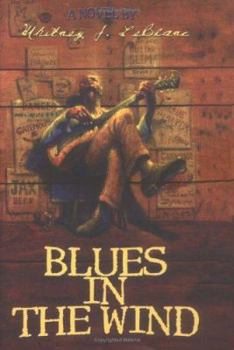
Blues in the Wind


Select Format
Select Condition 
Book Overview
First-time novelist LeBlanc has created a saga of the birth of the blues. In 1930s Louisiana, Phillip Fergerson's plans to become a doctor end when he falls for the beautiful light-skinned Martha.... This description may be from another edition of this product.
Format:Hardcover
Language:English
ISBN:0913515477
ISBN13:9780913515471
Release Date:January 2002
Publisher:River City Pub
Length:300 Pages
Weight:1.52 lbs.
Dimensions:9.0" x 1.3" x 6.0"
Related Subjects
Comics & Graphic Novels Fiction Genre Fiction Graphic Novels Historical Literature & FictionCustomer Reviews
3 ratings
Good Fiction, Possible Academic Uses
Published by Thriftbooks.com User , 17 years ago
"Blues in the Wind" is not the sort of book I'd pick up in a bookstore but one of the good things about reviewing books is that I get to see a wide range of genres. If I'm lucky the books are great too. I got luck with Whitney J. LeBlanc's first novel, number one of two books thus far in the story of the Fergerson family. Mixing insight into family dynamics and black American culture with historical events from the 1930 to 1954. LeBlanc's writing is fast paced and character driven, the history subtly woven into the mix as our characters become of aware of and influence events around them. Sometimes it felt like this was the world's most unlucky family but I guess an average family would be too boring for most readers. As I read I couldn't help but think how this might be used in a history class at the college level. A good way to assess student learning might be to assign this book at the midpoint of a semester about black history and then ask them to do a book review where they compare the historical events they've studied to how the Fergerson's lives are described. But if you aren't an educator and just want a fun book to read that will also educate, I highly recommend "Blues in the Wind".
Review of Blues in the Wind by Whitney J. LeBlanc
Published by Thriftbooks.com User , 21 years ago
In chapter One of Blues in the Wind, Whitney J. LeBlanc's first powerful novel, a character sets the tone of the book with: "man when Lightfoot plays the blues it's like a bolt of lightin' just struck the roots of a tree." Like the "blues" the wind that blows in LeBlanc's novel becomes a tornado that rips the roots of one Creole family and the segregated society of the 1930s-1950s in which it lives. The family is headed by "colored" Principal Phillip Fergerson and his beautiful wife, Martha who revels in her Creole heritage and who detests anything black (or "nigger" in her words). Martha's brother, Lightfoot, a cripple, also lives in the Fergerson house along with the Fergerson children, Bob, Velma, Lala and Rosa. The blues, enforced by the mores, customs and attitudes held within the family initiate the conflict of the story; the ebbs and flows of society's socio-political-religious environment fuels the action that makes the novel a dynamic work. LeBlanc draws heavily on his theatrical background to create characters that realistically become both initiators and receivers of the contradictions, suspense, discoveries, crises and spectacle in which the novel abounds. The profusion of idiomatic phrases, practices and customs reveal the depth of hidden meanings and messages in the twists and turns of the saga. This is, indeed, a tragic story full of hypocrisy, deceit and pain. The writing not only drags the reader into the excitement of each moment, but gives insights into the struggles of the past and presages the horrors that are still to come. The few moments of "uneasy peace" seldom last. LeBlanc deftly uses historical facts and events as transitions to ease the tensions. Only occasionally does LeBlanc's relentless passion to enlighten a generation ignorant of its own history slow down the whirlwind action as, perhaps, Phillips' involvement in voter registration effots that leads to his bloody beating. Even then, LeBlanc's ability to interweave fact and fiction gives depth and dimension to his writing and permits the reader to settle into the time and action. The moral of the action pushes to the front and, in the instant mentioned here, signals changes that will come to Phillip and his family. The reader fears the loss of Phillip's determination in the face of trials and tribulations--"like blues blown away by the wind." this fear, however, is short-lived as the family reunites only to fall victim again to Martha's mean and vindictive spirit. Finally the "lighting strikes the roots of the family" and plunges it into the tragic degeneration that ends the saga. Aficionadoes of the blues proclaim that "implicit in the term 'blues' is the whole tragedy of the black race." In the hands of Whitney LeBlanc, Blues in the Wind, his novel of the tragedy of one Creole family, gains universality and should demand widespread reading. Sequels to this first novel can be anticipated. Winona L. Fletche
Blues, Racism, and Family Drama in Gothic Louisiana Setting
Published by Thriftbooks.com User , 22 years ago
Blues in the Wind by Whitney LeBlanc has the grand makings of a Gothic, Southern novel. The time span from the 1930s to 1950s encompasses family drama, The Blues movement, the politics of segregation and race issues, along with the convoluted dynamics of color and identity that is indicative of the inhabitants in the state of Louisiana.Phillip Fergerson, though a product of mixed blood, is identifiable Colored; he cannot pass the paper bag test. He considers it a coup to marry the beautiful, unattainable Martha Broussard, whose milky white skin and white features are a sense of pride and joy and by which she sets herself apart from common Negroes. She, like her late father, revels in their Creole heritage. Her family, once wealthy landowners in Estilette, a town near Baton Rouge, lost their fortune to pure unadulterated racism. They might have looked white, but they are not, a bone of contention for her. Martha is a piece of work as she tries to direct the lives of her husband, her three daughters and son as well as her brother, Johnny "Lightfoot" Broussard. Lightfoot, as he is called in the Blues world, is a thorn in Martha's side. Immersed in the world of that "low-down, gut bucket music", as she calls it, he challenges her mores and values of color and class. Equally frustrating to her is Lightfoot's black skinned woman, Naomi; who is known to practice voodoo. But this is one thing she has no control over; Lightfoot, a guitar player, loves his Blues and his woman. Martha also concentrates on manipulating her children; Velma, Rosa, Lala, and Bobby. Velma has issues because she has short, nappy hair, a pasty complexion and Negroid features whereas Lala is light and beautiful with long straight hair and gray eyes. Velma, like her mother, is color-struck and mean-spirited. By Phillip being the superintendent of Colored schools, the Fergersons have a special status in town. Frustrated and lonely in his marriage, Phillip seeks solace in Alicia, a professor at Southern College in Baton Rouge. He also leaves the Catholic Church when the priest questions his integrity and becomes a Baptist. Martha is horrified to say the least. Phillip continually finds himself disillusioned and at odds with the white hierarchy of Estilette. His children are trying to find their way, making decisions that torment their parents. To Martha's distress, Lala takes her piano playing from the Catholic Church to the Baptist Church and then to the juke joints, creating an irreversible breach between mother and daughter. Velma's lack of self-esteem leads her into a world of vices, while Rosa wanders into an affair with a priest.I wanted to embrace this novel as soon as my book club sisters brought this book back from BEA last year, immediately identifying it as my kind of read. I wish I had not waited so long. The historical context of the time period and place was illuminated with a renowned cast of Blues folks that passed through the juke joints, such as Leadbelly, Bessie Sm
Copyright © 2026 Thriftbooks.com
Terms of Use | Privacy Policy | Do Not Sell/Share My Personal Information | Cookie Policy | Cookie Preferences | Accessibility Statement
ThriftBooks ® and the ThriftBooks ® logo are registered trademarks of Thrift Books Global, LLC
ThriftBooks ® and the ThriftBooks ® logo are registered trademarks of Thrift Books Global, LLC
