


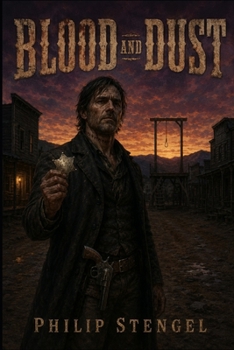
Blood and Dust

They wrote the town's name in a ledger and called the ledger the law.
Silas Graves swore he would never set foot in Redemption again. He rides back anyway, because a promise made over a grave is the kind of debt a man cannot outrun.
Redemption sits in a shallow basin where the smoke never fully clears and every roof leans a little toward the courthouse. It is the kind of place that learned to stay alive by looking away. Silas is about to give it a reason to look up.
The town he left has a new master. Marshal Cyrus Graves rules it under a single line of territorial law, Article 7, and that line has become a rope, a curfew, and a ledger that records what every family owes and every reason it can be erased. The levy moves door to door, a deputy with a lockbox and a list, and a signature costs more than coin. It costs the last thing a proud man owns. People bow their heads and pay. The ones who cannot pay swing in the square as a lesson to the rest. Silas came home to bury the past. What he finds is a valley being stolen one signature at a time, run by a marshal who shares his blood and his name.
He is not the only one left who refuses to kneel. A saloon owner who counts the years her neighbors have left to live. A doctor who trades in the kind of quiet favors the town would hang him for. A crippled liveryman who knows the back country better than any road. A preacher's daughter named Elara Martin, who learned young that calm can keep a person alive, and that when it has to, calm can be a weapon. Together they decide that fear is not the same thing as agreement, and they go after the one thing that makes the marshal feel safe. His records. Burn the ledgers, and a town loses its chains and its proof in the same fire.
Out here the law arrives the way weather does, late and shaped by whoever stands in its path. A page pressed in a far office turns a theft into a levy and a killing into an execution. Whoever holds the ledgers holds the people, because the ledgers decide who owns, who owes, and who can be made to disappear.
The fire does not end it. It wakes something.
Cyrus is only a hand. Behind him stands a wider machine, a web of telegraph wire and ink and men who will never ride through the valley they own. They move towns and mines the way a clerk moves entries, with distance and a stamp and no need to raise their voices. His enforcer, a cold and patient deputy named Cort Rannoch, does not rage when the records burn. He simply starts hunting. Silas set out to settle a private account with the man who wears his name. He learns the account is far larger than one marshal, one town, or anything a single Colt can close.
Now he and the handful who stood with him run east through tunnels and dead mines and burning ground, carrying names that powerful men need erased. They have proof. Proof is only worth what someone with more power decides to do with it, and every mile they cover, the wire hums a little louder behind them. For the first time in a long time, the fear in the valley runs both ways.
BLOOD AND DUST is a lean, hard-edged Western about power that hides behind paper, the courage it takes to refuse it, and the cost of the first shot fired back. It is the opening move in a larger story, and the ground it stands on has already begun to shift.
Perfect for readers who love:
Gritty, character-driven frontier WesternsFrontier-justice thrillers with real stakes and a body countSlow-burning dread and a wide, patient conspiracyA flawed hero and a villain who never has to raise his voiceThe rope still stands in the square. The ledger is out of the marshal's hands, and somewhere down the wire, men who have never seen this valley have begun to wonder who is reading it. The wind keeps a longer record. Turn the first page.
Customer Reviews
ThriftBooks ® and the ThriftBooks ® logo are registered trademarks of Thrift Books Global, LLC
