


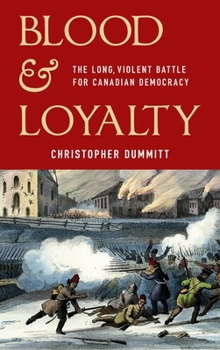
Blood & Loyalty: The Long Violent Battle for Canadian Democracy

If your reading of history has left you with the impression that Canada's formation was lacking something in American-style revolutionary drama, read on.
While the country's self-governance may have come about peacefully in 1867, it began decades earlier on blood-soaked streets, in the aftermath of the violent rebellions of 1837-38. Those insurgencies gave rise to a new generation of Canadian visionaries who built democracy through assertive, independent-minded loyalty. In embracing and reshaping British political institutions, reformers like Robert Baldwin, Louis- Hippolyte Lafontaine, and Joseph Howe turned defeat into a breakthrough. Their struggle culminated in 1849, when angry mobs burned the Parliament buildings in Montreal--a fiery symbol of how hard-won self-government truly was, and how fragile it can be.
For Canada in the twenty-first century, the importance of not taking self-governance for granted has again become an urgent issue. Deeply researched and rivetingly written, Blood & Loyalty shows that the country's political story is one of loyalty and reform, compromise and powerful assertiveness. It is a timely reminder of what makes Canada Canada.
Customer Reviews
ThriftBooks ® and the ThriftBooks ® logo are registered trademarks of Thrift Books Global, LLC
