


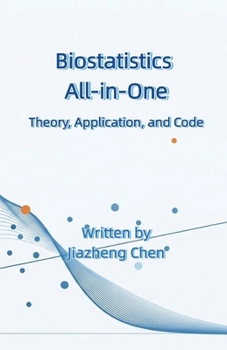
Biostatistics All-in-One: Theory, Application, and Code

Theory, application, and code-together on every page.
Biostatistics rewards those who grasp not just which test to run, but why it works and how to carry it out. Biostatistics All-in-One brings all three together in a single volume: the reasoning behind each method, the settings where it matters, and working code you can run today.
Spanning 46 chapters and 7 appendices, the book moves from descriptive statistics and the logic of hypothesis testing through correlation and regression, generalized linear models, survival analysis, probability and Bayesian thinking, resampling, multiple imputation, causal inference, and the design of modern clinical trials-all the way to regularization, multivariate methods, and clustering. Concepts are built from first principles, then put to work on realistic problems, so the ideas stick.
What sets this book apart is that every method is demonstrated four ways-in R, SAS, SPSS, and Stata-using original, fully verified datasets. Whatever software your lab, clinic, or journal expects, you can reproduce every result and carry the analysis over without translation headaches. Chapter 40 and a dedicated appendix map the four packages command-for-command, and the text flags the default-setting differences (reference categories, confidence-interval methods, continuity corrections) that most often make results "disagree" across software. Every number in the book is real. The datasets are original, and every formula, figure, and code listing has been computed and checked, so what you read is what you get when you run it.
Inside you will find:
Every method worked four ways, in R, SAS, SPSS, and StataOriginal datasets; every formula, figure, and code listing computed and verifiedFrom first principles to survival analysis, Bayesian inference, and clinical-trial designA four-package command guide, distribution tables, worked datasets, and a glossary in the appendicesA recurring focus on the traps-confounding, non-collapsibility, overdispersion, multiple testing, and the difference between statistical and practical significanceWho this book is for: graduate students in public health, medicine, and the life sciences; researchers and clinicians who analyze their own data; and practicing biostatisticians who want a dependable, code-first desk reference across four software packages. Newcomers will find a clear path from the ground up, while experienced analysts gain a reliable bench companion.
From your first histogram to your next survival curve-keep it within reach.
Related Subjects
Math Mathematics Medical Medical Books Science Science & Math Science & Scientists Science & TechnologyCustomer Reviews
ThriftBooks ® and the ThriftBooks ® logo are registered trademarks of Thrift Books Global, LLC
