


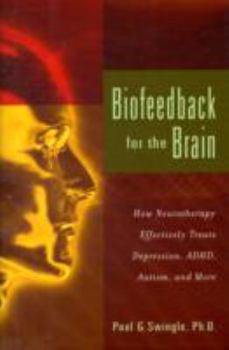
Biofeedback for the Brain: How Neurotherapy Effectively Treats Depression, ADHD, Autism, and More

Select Format
Select Condition 
Book Overview
Neurofeedback is a cutting-edge, drug-free therapeutic technique used by over a thousand licensed therapists in North America to treat a range of conditions from attention deficit and hyperactivity disorders to epilepsy, stroke, anxiety, migraine, and depression. First popularized in the 1970s, this naturalistic method is based on the idea that we can control our brain activity and that, through training, the brain can learn to modify its own electrical patterns for more efficient processing or to overcome various states of dysfunction. In Biofeedback for the Brain , Dr. Paul G. Swingle describes in clear and coherent language how these procedures work. With numerous actual case examples, readers follow the progress of clients from the initial "brain map" that shows the location and severity of the neurological abnormalities to the various stages of treatment. Conditions often considered untreatable by conventional health practitioners respond positively to neurotherapeutic treatment and Swingle describes many of these remarkable recoveries. Other chapters describe the use of neurotherapy for a variety of surprising purposes, including performance training for elite athletes, of which the most famous example is the Italian soccer team who considered the technique to be their "secret weapon" in attaining a World Cup victory. Despite wide-ranging success stories and the endorsement of the American Psychological Association, many health care practitioners remain skeptical of neurofeedback and the procedures are still not well-known by the public or conventional health care providers. This book provides a thorough, definitive, and highly readable presentation of this remarkable health care alternative that offers millions of individuals a chance for healing.
Format:Hardcover
Language:English
ISBN:0813542871
ISBN13:9780813542874
Release Date:May 2008
Publisher:Rutgers University Press
Length:220 Pages
Weight:1.12 lbs.
Dimensions:9.5" x 1.0" x 6.3"
Age Range:16 years and up
Grade Range:Grade 11 and higher
Customer Reviews
3 ratings
This is an excellent book on neurofeedback
Published by Thriftbooks.com User , 16 years ago
Biofeedback for the Brain is a fabulous book because it really explains what neurofeedback is as well as what the practitioner does to help a client. I like the description of the detailed assessments of the different parts of the brain. I especially like Dr. Swingle's philosophy of working with clients. He sounds like a very caring person, who respects each of his clients. I really appreciate how he looks for the positive in each person's brain patterns and speaks to the person about this. The medical model of focusing on what is wrong is often too prevalent in this field, and his approach is quite refreshing. I am working on my neurofeedback certification, and this has been one of the most helpful books that I have read thus far. He writes with intelligence, a sense of humor, and he often gives examples to help illustrate what he is explaining.
Overall, a good introductory book on biofeedback/neurofeedback
Published by Thriftbooks.com User , 17 years ago
Biofeedback for the Brain is a challenging book to rate: it provides a wealth of information (especially for those unfamiliar with biofeedback/neurofeedback) and gives an excellent overview on the subject. The problem with it, unfortunately, is that it also contains some, but not all, of the pitfalls common to other books on the matter. To begin with, I'd like to comment on the positive elements. Swingle provides a highly accessible look at just what neurofeedback does and what it is capable of doing. Its uses are well explained and the book provides good descriptions of why this form of biofeedback is appropriate in many situations. The examples discussed represent a broad overview of the types of maladies that may be served: ADD/ADHD, autism, depression, OCD, TBI, etc. as well as how these may be diagnosed and treated through neurofeedback. The author also discussed potential useful alternative/adjunct therapies that may contribute to intervention strategies: these include audio/visual stimulation (AVS), electrocranial stimulation, and brainwave entrainment techniques. As mentioned earlier, there are several problems with this book some of which may, or may not, have been the result of decisions by the author. When reading books on neurofeedback, I constantly look at the references that are provided as this provide a good clue into the veracity of the book's contents (in other words, is the book based upon sound scientific principles or, in the case of alternative medical approaches, merely new age nonsense) - while Swingle does, for the most part, use very good sources, these sources are also limited as many of the same journals are cited over and over again. While there is nothing wrong with this, per se, it would have been more appropriate (if possible) to have used a greater number of peer reviewed journals. The problem with this, however, may not have been the author's fault as neurofeedback has not yet been fully studied and many refuse to admit that it is worth studying. The real problem I have with the book concerns the ongoing promotion of the author's own practice and materials. While this is not as blatant as what I've read in other books (especially, The Healing Power of Neurofeedback: The Revolutionary LENS Technique for Restoring Optimal Brain Function), it is still present. A few of the web sites cited concerning materials belong to the author. One item, in particular, caught my attention and that was Swingle's mention of his "attention harmonic" some type of sound that he has produced on a CD. While this may, or may not, be a valuable tool to use, the author provides very little information as to what, exactly, this "attention harmonic" is: in fact almost all sounds have harmonics. Why is Swingle's sound different? What are the characteristics of that sound? This type of problem is evident throughout the book - good, or potentially good, techniques are discussed but little specific information is often given so that a knowledg
This Book Opens Whole New Worlds of Healing and Growth to Laymen and Professionals
Published by Thriftbooks.com User , 18 years ago
Author Paul Swingle is one of the pioneers in the field of Brain biofeedback and the related neurotherapies. Let me be clear that he has not just been IN the field since its early days. He has played an active, creative, dynamic role in pioneering important approaches and techniques. This book has been long awaited as a practical exploration and discussion of the wide ranging approaches and models he's helped to establish. As founder of the Futurehealth Winter Brain Meeting, which has often been credited with being the first conference on neurofeedback, it has been a pleasure to have Dr. Swingle as a speaker every year of the conference, where his new, innovative, integrative approaches has always drawn a strong audience-- where he's training the trainers. What Dr. Swingle does best is put powerful ideas and approaches together in a way that maximizes their synergy and effectiveness. This book introduces the reader to not just neurofeedback, but the collection of ancillary techniques that make it work much better and faster. If this were a meal, the ancillary techniques would be the fork, spoon, salt and pepper, and the many additional exotic spices that turn ordinary table fare into gourmet delight. Swingle adds his innovative approaches to the basic brainwave training that thousands do, and that's why he has one of the most successful practices in the world, and I've seen many of those other practices. This book is for both laymen and professional biofeedback practitioners. If you are a layman, considering neurofeedback, this book will give you a good idea of both the breadth of the applications and the wide range of related approaches that work well with it. If you are a practitioner of neurofeedback, not trained by Dr. Swingle, then this book will probably open up whole new worlds of technologies and approaches you never considered as viable, valuable parts of your practice.
Copyright © 2026 Thriftbooks.com
Terms of Use | Privacy Policy | Do Not Sell/Share My Personal Information | Cookie Notice | Cookie Preferences | Accessibility Statement
ThriftBooks ® and the ThriftBooks ® logo are registered trademarks of Thrift Books Global, LLC
ThriftBooks ® and the ThriftBooks ® logo are registered trademarks of Thrift Books Global, LLC
