


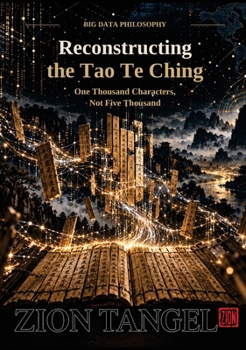
BIG DATA PHILOSOPHY Reconstructing the Tao Te Ching: One Thousand Characters, Not Five Thousand

What if the earliest recoverable core of the Tao Te Ching was not five thousand characters, but closer to one thousand?
In Reconstructing the Tao Te Ching, physician and independent researcher Zion Tangel challenges the assumption that the familiar eighty-one-chapter text represents a single, original composition. Drawing on the Guodian bamboo manuscripts, the Mawangdui silk texts, and later transmitted versions, he asks how the book took shape and what its successive layers reveal.
Using AI-assisted comparative analysis, linguistic patterns, character forms, and internal logic, Tangel argues that Guodian Laozi A preserves a coherent philosophical core. He examines shifts in vocabulary, recurring explanatory formulas, and changes in argument to trace what he interprets as successive stages of supplementation and editing. Rather than reconstructing the entire received text, the book concentrates on rebuilding this core into a continuous, numbered text that readers can examine and cite.
The investigation also returns to practical questions: What is the relationship between Dao and De? What does noncoercive action mean? How can a shared principle take different forms in government, family life, and everyday work? Tangel presents his own interpretations while distinguishing surviving manuscript readings from proposed restorations.
Comparative tables, manuscript illustrations, detailed discussions, and extensive appendices make the argument available for scrutiny. Readers can follow the evidence, compare versions, and consider the reconstruction for themselves.
Part of the Big Data Philosophy series, this book offers a provocative reexamination of a foundational Chinese text and an invitation to read familiar words with fresh eyes.
Short Description(201 UTF-8 bytes,低于250)
Was the Tao Te Ching originally a thousand characters? Zion Tangel uses AI-assisted textual comparison to argue for Guodian Laozi A as its earliest coherent core and presents a numbered reconstruction.
Related Subjects
PhilosophyCustomer Reviews
ThriftBooks ® and the ThriftBooks ® logo are registered trademarks of Thrift Books Global, LLC
