


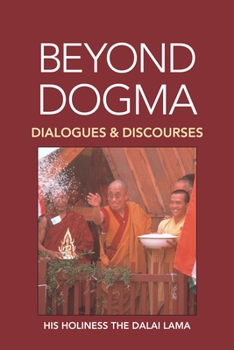
Beyond Dogma: Dialogues and Discourses

Select Format
Select Condition 
Book Overview
Beyond Dogma presents a record of a 1993 visit to France by His Holiness the Dalai Lama, recipient of the 1989 Nobel Peace Prize and the world's most prominent Buddhist leader. During a series of... This description may be from another edition of this product.
Format:Paperback
Language:English
ISBN:1556432186
ISBN13:9781556432187
Release Date:June 1996
Publisher:North Atlantic Books
Length:248 Pages
Weight:0.90 lbs.
Dimensions:0.7" x 6.0" x 8.9"
Related Subjects
Buddhism Occult Philosophy Politics & Social Sciences Religion Religion & SpiritualityCustomer Reviews
4 ratings
God Bless the Delhi Lama
Published by Thriftbooks.com User , 18 years ago
I had picked this book up in a bookstore and it fell to a page which had a question regarding sexuality and the answer given by the Delhi Lama. I later bought this book thinking it had a certain degree of information regarding exoteric beliefs and practices of the Buddhists. It does contain some information to this end but not to the degree that I had anticipated. Anyways, this was the question that was asked: "What are improper sexual attitudes? What do you think of homosexuality, for example?" "Something may be considered improper in terms of organs, time and place-where sexual relations involve inappropriate parts of the body or when they occur at an unsuitable time or place. These are the terms Buddhists use to describe sexual misconduct. The inappropriate parts of the body are the mouth and the anus, and sexual intercourse involving those parts of the body, whether with a man or a woman, is considered sexual misconduct; masturbation as well. As for when sexual intercourse takes place, if it is during the day, it is also held to be a form of misconduct, as is having intercourse with a partner who professes to certain principles such a sexual abstinence or celibacy, even if those vows are only temporary. To force someone to have intercourse also comes under the category of improper time. Inappropriate locations include temples, places of devotion, or positions where one partner is uncomfortable. A sexual act is deemed proper when the couple uses the organs created for sexual intercourse and nothing else. To have sexual relations with a prostitute paid by you and not by a third person does not, on the other hand, constitute improper behaviour. All these examples define what is and what is not proper sexual behaviour according to Buddhist morality. Homosexuality, whether it is between men or between women, is not improper in itself. What is improper is the use of organs already defined as inappropriate for sexual contact. Is this clear?" Pg 46. As you read on into this book, you discover that there are those Buddhist monks of the same sex who would have sexual contact involving copulation between the thighs of the partner; a sexual action that avoided committing an expellable offence, since it did not involve penetration of the mouth or anus of the partner. It is however mentioned that this practice is shunned ultimately within the monasteries. Having sex with a person of the same sex utilising their thighs, still falls into the same basket of homosexual masturbation as far as I'm concerned. Hey, the Delhi Lama said it, not me. The comments above by the Delhi Lama apparently created quite a storm with the homosexual community in the USA. Interesting how the above comments by the Delhi Lama are formulated, sounds like condoning to me. Still sometimes with masters (?) they will teach one thing to the masses and another to those who have gone deeper. Yeah this is a bit of a stretch, but if you want a spiritual philosophy that says it's okay to p
Before the Reformation and Religious Reliance
Published by Thriftbooks.com User , 21 years ago
Cavemen at one time had no religion but mere observations about their world with which to determine how they would treat each other, their world, and the other animals on earth with them. They had no benefit of religious interpretation, from any sect, no corporate guidance, or training, and no organized government to determine the sense of justice, or how to increase it. Yet, they survived! We know they survived because we live today. If we cannot improve on the efforts cave men used to define their world, we would be more ignorant than we think they were. In fact, they may have been smarter, or lived in a less complex world, for now the complexity we have does not assure a good result, nor one humane for today's world. To prevent going backwards rather than forwards, it may be necessary to contain religious ritual and dogma in a place reserved for personal belief, which we go beyond religion, or transcend it, to deal with the many different groups that man up the world, some religious, some not. Only government can do that, based upon personal responsibility simpy by recognizing that man is alive and is a part of the entire human race alive during his life. Conscientious development is the only reality and logic that makes sense to be all inclusive. Choosing the humanity of life, rather than the scorekeeping of religious dogma is required to maintain both order and morality since morality is uniquely clannish arising as it does from whichever religious sect imposes it. The doctrine of fairness and recognition requires that we reach beyond the narrow confines of different religions to see the world that exits around it in a mission of world survival, undaunted by tribal concerns and secular groups that are the unique styles of those particular groups. Ignoring religion may be much more important than ignoring humanity.
An amazing book by an amazing man
Published by Thriftbooks.com User , 24 years ago
After reading two books by the Dalai Lama, I can honestly say I would rather meet this one person more than anyone else alive today. He is an incredible man who has gone through many hardships but continues to have a positive outlook on humanity and even the men who occupy his country to this day.You do not have to be Buddhist or even religious at all to gain a lot of insight from Beyond Dogma. As the title of the book implies, he really is the prime example of tolerance. He suggests it might be better for some people not to get stuck up on ceremonies or tradition and focus on what is important instead. Most religions at the heart are found on kindness, generosity, and humility. In fact, he speaks of several priests who took Buddhist vows but remained Christians because in essence, these virtues do not conflict. So he reaches out to people of all backgrounds. Part of this tolerance is because much of Buddhism does not require the same leaps of faith as other religions. You can reason through most of his discussions; you do not have to immerse yourself in scripture to understand what he says. He describes Buddhism as the Middle Way - between faith-based religion and secular philosophy - making it accessible to everyone.His most recent book, the Art of Happiness, was very popular for its life-changing aspects. In addition to his sagely advice, this work also deals with international relations amongst differing religions and governments. Not surprising since it was written shortly after the Dalai Lama won the 1989 Nobel Peace Prize and consists of interviews while visiting France in addition to narratives. He embraces the idea of a 'New World Order' like few other modern leaders have had the bravery to do.The Dalai Lama is not a religious icon hidden away from the world; he discusses real-life problems in a modern society that is far removed from the mystical city of Lhasa. Meanwhile, he can still apply a wealth of knowledge from a vast amount of information from many fields. If you are anxious to learn more about Buddhism, Tibet, the East, or the Dalai Lama himself, this is a great book to own yourself or to give to curious friends.
My own spiritiual quest started here...
Published by Thriftbooks.com User , 24 years ago
Browsing through a bookshelf with only the most vague notion of what I was looking for, my eyes were caught by the simple and yet powerful title of this book. At the time, I had little idea of what Buddhism was, and yet the title itself conveyed to me everything that seemed wrong with the religon of my upbringing.Beyond Dogma is an inciteful and well-written treatise. It is one of my favorites written by the Dalai Lama, and the translation provides great clarity to his words. The autobiographical background of the Dalai Lama and the last fifty years in Tibet is in excellent context with the nature of Tibetan Buddhism. An excellent and easy read that is light on the complex theory and heavy on warmth and understanding.
Copyright © 2026 Thriftbooks.com Terms of Use
| Privacy Policy | Do Not
Sell/Share My Personal Information | Cookie Policy | Cookie Preferences | Accessibility Statement
ThriftBooks® and the ThriftBooks® logo are registered trademarks of Thrift Books Global, LLC
ThriftBooks® and the ThriftBooks® logo are registered trademarks of Thrift Books Global, LLC
