


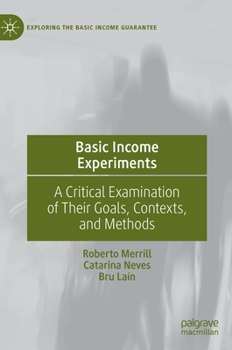
Basic Income Experiments: A Critical Examination of Their Goals, Contexts, and Methods

Acknowledgements
Chapter 1: Introduction
1.1. UBI and conditional transfers
1.2. The surge in UBI experiments and their limitations
1.3. Methodology
1.4. Our interviewees
1.5. The case studies
1.5.1. Experiments from the '60s to '70s in the USA and Canada
1.5.2. Alaska's Permanent Fund
1.5.3. Outline of our case studies
1.5.4. The experiments in India
1.5.5. The experiment in Namibia
1.5.6. The experiment in Finland
1.5.7. The experiment in the Netherlands
1.5.8. The experiment in Ontario
1.5.9. The B-MINCOME experiment in Barcelona
1.5.10. The GiveDirectly experiments in Kenya
1.5.11. The experiments in the USA: Stockton Economic Empowerment Demonstration (SEED)
1.5.12. The Eastern Band of Cherokee Indians' dividend (USA)
1.5.13. Macau's Wealth Partaking Scheme
1.5.14. Renda B?sica da Cidadania - the local currency policy in Maric?, Brazil
1.5.15. Youth Basic Income policy in South Korea
1.5.16. Iran's universal subsidy policy
1.5.17. Basic Income Pilot Project in Germany
1.5.18. The Basic Income debate in Scotland
1.6 The outline of the book
References
Part 1: What we have learned from the interviews
Chapter 2. The goal, context, and methods behind our case studies
2.1. What goals are behind our case studies?
2.2. Can we really call them UBI experiments?
2.3. The role played by methodological decisions
2.4. The role of the context: UBI experiments do not occur in a vacuum
References
Chapter 3. What do our case studies tell us?
3.1. Do we already know enough?
3.1.1. Welfare and health benefits
3.1.2. Labor market participation
3.1.3. Autonomy
3.1.4. Economic activity
3.1.5. Investments in Education
3.2 Experiments play several roles
ReferencesPart 2: New questions the interviews have raised
Chapter 4. The decision to implement UBI experiments
4.1 Moral and instrumental arguments to implement UBI experiments
4.2 Social scientists and politicians
4.3 How the debate, political scenario and the welfare model frame the decision to implement UBI experiments
4.4 Experiments' features are more due to political reasons than scientific ones
References
Chapter 5. How results are interpreted
5.1 How results are interpreted and analyzed: the context and the objective of experiments
5.2 National and international media coverage
5.3 Additional related effects that received less attention
5.3.1. Identity, power relations and community engagement
5.3.2. Empowering women
5.3.3. Community empowerment and trust
5.3.4. Shortcomings of unconditional cash grants
References
Chapter 6. From experiment to policy implementation? 121
6.1 Basic income experiments: their role as political and research tools 121
6.2 Experiments: political opportunity costs, manipulation, and populism 124
6.3 Experimenting or lobbying: which path forward? 127
References to Chapter 6 131
Part 3: How to answer the new questions about basic income experiments, pilots and policies?
Chapter 7 How the findings from out interviews help advance the Basic Income debate and advocacy
7.1 Do we still have questions?
7.2 In between mo
Related Subjects
Business Business & Investing Economics Political Science Politics & Social SciencesCustomer Reviews
ThriftBooks ® and the ThriftBooks ® logo are registered trademarks of Thrift Books Global, LLC
