
Skip to content
Scan a barcode
Scan
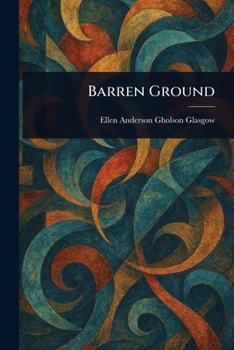
Paperback Barren Ground Book

ISBN: 1023471906

ISBN13: 9781023471909

Barren Ground

Select Format

Select Condition ThriftBooks Help Icon

Recommended

Format: Paperback

Condition: New

$23.95
Ships within 2-3 days
Save to List

Book Overview

Ellen Anderson Gholson Glasgow's "Barren Ground" offers a compelling portrait of rural life in the Virginia Piedmont. A powerful work of Southern literature, the novel explores the challenges and resilience of women in a changing agricultural landscape. Set against the backdrop of early 20th-century farm life, the story delves into themes of perseverance and self-reliance. Glasgow's meticulous attention to historical detail brings the era to life, capturing the spirit of a community shaped by its connection to the land. "Barren Ground" is a timeless exploration of the human spirit, resonating with readers through its vivid characters and evocative depiction of place. A classic of women's fiction, it provides a moving and insightful look into a bygone era.

This work has been selected by scholars as being culturally important, and is part of the knowledge base of civilization as we know it.

This work is in the public domain in the United States of America, and possibly other nations. Within the United States, you may freely copy and distribute this work, as no entity (individual or corporate) has a copyright on the body of the work.

Scholars believe, and we concur, that this work is important enough to be preserved, reproduced, and made generally available to the public. We appreciate your support of the preservation process, and thank you for being an important part of keeping this knowledge alive and relevant.

Customer Reviews

5 ratings

Personal triumph of a solitary female

Barren Ground is an overlooked classic that is still relevant today. I would never have read it myself except that it was required reading in a college class on great american novels of the 20th century. I wonder sometimes if its lack of popularity is because the story concerns a young woman who forsakes the love of man and determines to have a meaningful, rewarding life on her own. The heroine, Dorinda, is betrayed by her lover. She ultimately builds a successful life as a single female (quite a revolutionary thought for a turn-of-the century novel!). Dorinda's life mirrors in many ways the life stories of actual women I have known, woman who have had to make their own way in the world due to death or divorce. If I were a high school english teacher, I would make this required reading for every girl in my class.

Barren is the word for it all!

Ellen Glasgow is largely forgotten now and this is a pity because she was a talented writer. "Barren Ground" and "Vein of Iron" are her best known works and in their time, the first half of the last century, they were highly regarded "Barren Ground" is sometimes taken by feminists as a tract for their side. They are wrong. It is true that the protagonist, Dorinda, successfully makes her way in the man's world of the turn of the last century. Having been viciously jilted by her lover the twenty-year old Dorinda flees her impoverished Virginia homestead only to return two years later and gradually transform it into a showplace farm. In the process she is amply revenged on her faithless lover and becomes a wealthy and moderately powerful woman of admired character. So far, so good. But, the title "Barren Ground" says it all. The Virginia farmland Dorinda inherits, worn out from years of tobacco culture, is indeed nearly barren. A pernicious weed, the bloomsedge, has invaded the sterile landscape and it must be plowed under if anything of value is to bloom. Thus far the obvious metaphor for Dorinda and her need to transform herself into something vital and valuable after her tragic young adulthood. But, the title of the book is ironic. The land is, indeed, reclaimed by Dorinda and made fruitful again. It is Dorinda who remains barren -- both literally and figuratively -- to the last page. It must occur to any careful reader that Dorinda is, in fact, psychologically unbalanced. Her 'jilt" at the age of twenty becomes the determining factor in her life. For most people, it is an episode. In page after page of over-wrought prose Ms. Glasgow takes us through Dorinda's ridiculously over-wrought reaction to being dumped. Whole chapters describe her inner turmoil and bitterness and after only a few pages the message becomes clear: Dorinda is mildly psychotic. The second half of the book extends Dorinda's story from about 1893, when she is dumped, to 1923. During that time Dorinda uses the excuse of her musty, long-ago love affair, as an rationale for her utter lack of empathy toward others and her total self-involvement. She feels no grief when her loving father dies -- a man she mentally compares with a horse -- and has not even a trace of sympathy for a brother who fears for his life after having killed a man. When she finally does marry it is solely for reasons of gain and she is dismissive of her husband -- a man so intelligent and saintly that after his death the impoverished community erects a monument to his memory! Dorinda is the classic ice-queen. Time and again the author tells us, and Dorinda reiterates, that she is repulsed by physical sex. She cannot,in fact, bear to be touched. There is not a single hint in the book, though, that she is attracted to women. While she maintains her surface decency Dorinda becomes one of those against whom Hawthorne warned us -- one who has lost hold of the magnetic chain of humanity. Dorinda bears no chil

Reader

Excellent. One of her best novels. The prevalent element of naturalism strongly reinforces the theme and setting of the story, giving the reader a good taste of southern literature. The growth of Dorinda's character can be measured by the symbolism of each of the three parts of the novel (broomsedge, pine, and life-everlasting). A wonderful addition to women's literature as well as southern literature.

Great Glasgow book

This lengthy story covers the life of a farm girl in rural Virginia around 1890 through the early 1920's. The novel starts out with her madly in love with another villager. A day before her wedding she is dumped. Her financee decides he is going to marry another villager. She decides she is through with love and finds that men are more trouble than they are worth. The character's reasons, resoltuions, and actions are extremely admirable. Not focusing on relationships, she is able to rise from poverty to run a successful dairy farm. On the other hand, just about everyone else in the town become failures and poor (including her financee and his wife). Sometimes, I found myself admiring the main character, Dorinda, and other times feeling pity that her loveless life was filled with work only. It seemed one-faceted and at times filled with biting man-hating resentment. There was a lot of substance to this book and much could be written and studied about it. Another book to be filled under "read again."This is definitely one of Glasgow's best pieces of work.

Glasgow's breakthrough style is amazing

The spirit of human triumph and Glasgow's breakthrough style are amazing. THe book is so three dimensional and a wonderful read.
Copyright © 2026 Thriftbooks.com Terms of Use | Privacy Policy | Do Not Sell/Share My Personal Information | Cookie Policy | Cookie Preferences | Accessibility Statement
ThriftBooks ® and the ThriftBooks ® logo are registered trademarks of Thrift Books Global, LLC

GoDaddy Verified and Secured