


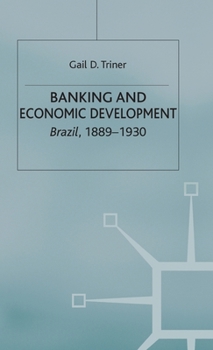
Banking and Economic Development: Brazil, 1889-1930
No Customer Reviews

A banking system emerged in Brazil during the early 20th century that was efficiently and productively supported by economic development. However, it also contained the seeds of its future limitations. This banking system did not equalize conditions across sectors or regions as existing theory and historiography anticipated. Deeply embedded institutional constraints limited banking's contribution to long-term development. The three most important institutional constraints were insecure property rights, continual tension between the system's public and private sector functions, and competition between the Federal State and the states. Nevertheless, the banking system was an effective tool in the consolidation of an economy of national scope during these crucial years. As a modern banking system emerged, its use in national consolidation both magnified and reflected its limitations.
Format:Hardcover
Language:English
ISBN:031223399X
ISBN13:9780312233990
Release Date:February 2001
Publisher:Palgrave MacMillan
Length:333 Pages
Weight:1.22 lbs.
Dimensions:0.8" x 5.5" x 8.5"
Customer Reviews
0 rating
Copyright © 2026 Thriftbooks.com
Terms of Use | Privacy Policy | Do Not Sell/Share My Personal Information | Cookie Policy | Cookie Preferences | Accessibility Statement
ThriftBooks ® and the ThriftBooks ® logo are registered trademarks of Thrift Books Global, LLC
ThriftBooks ® and the ThriftBooks ® logo are registered trademarks of Thrift Books Global, LLC
