


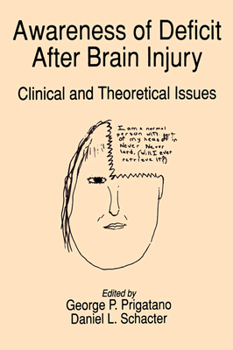
Awareness of Deficit After Brain Injury

Select Format
Select Condition 
Book Overview
This volume provides, for the first time, multidisciplinary perspectives on the problem of awareness of deficits following brain injury. Such deficits may involve perception, attention, memory, language, or motor functions, and they can seriously disrupt an individual's ability to function. However, some brain-damaged patients are entirely unaware of the existence or severity of their deficits, even when they are easily noticed by others. In addressing these topics, contributors cover the entire range of neuropsychological syndromes in which problems with awareness of deficit are observed: hemiplegia and hemianopia, amnesia, aphasia, traumatic head injury, dementia, and others. On the clinical side, leading researchers delineate the implications of awareness of deficits for rehabilitation and patient management, and the role of defense mechanisms such as denial. Theoretical discussions focus on the importance of awareness disturbances for better understanding such cognitive processes as attention, consciousness, and monitoring.
Format:Hardcover
Language:English
ISBN:0195059417
ISBN13:9780195059410
Release Date:January 1991
Publisher:Oxford University Press
Length:288 Pages
Weight:0.70 lbs.
Dimensions:0.7" x 6.2" x 9.3"
Customer Reviews
1 rating
An amazing book detailing a difficult phenomenon
Published by Thriftbooks.com User , 27 years ago
The book explains a condition called anosognosia which brain injured individuals may experience. As the title explains, anosognosia basically describes an unawareness of deficits. Although much has been written about brain injuries, this extremely important facet of the recovery process is rarely addressed. I am brain injured myself and learned more about my own condition from this book than I have learned in all the other seventeen post-morbid years put together. It is written in highly technical language, more for professionals, I'd guess, than the lay person. All the same, I (a lay person) found it great reading and had no trouble understanding its content.
Copyright © 2026 Thriftbooks.com
Terms of Use | Privacy Policy | Do Not Sell/Share My Personal Information | Cookie Policy | Cookie Preferences | Accessibility Statement
ThriftBooks ® and the ThriftBooks ® logo are registered trademarks of Thrift Books Global, LLC
ThriftBooks ® and the ThriftBooks ® logo are registered trademarks of Thrift Books Global, LLC
