


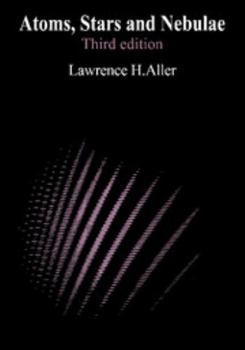
Atoms, Stars, and Nebulae


Select Format
Select Condition 
Book Overview
In a nontechnical fashion, this book tells the story of how astronomy and physics work together to unravel many mysteries of stars and nebulae. Professor Aller's descriptions stress deeper understanding of these objects, not just a mere review of facts. After a succinct, nonmathematical excursion into the principles of radiation and atomic structure, he explains in simple terms the physical processes at work in stars and gaseous nebulae. A survey of masses, dimensions, luminosities, temperatures, and chemical compositions of stars is followed by an exploration of their interiors and how stars generate energy. The life histories of stars, from origin through final demise, sometimes through variability to beautiful nebulae, sometimes via violent explosions as supernovae, is recounted in detail. The exotic life histories of many double stars, some of which produce novae, are also described, and the origins of chemical elements in dense stellar cores and the vital role played by gas and dust between the stars is explained. The book closes with an account of the exciting new field of high-energy astronomy and the origin of cosmic rays. This is the ideal introduction to the important field of modern astrophysics for physics and astronomy students. It should also appeal to amateur astronomers interested in the life history of a star, be it a modest one such as our sun or a massive object destined to become a supernovae.
Format:Paperback
Language:English
ISBN:0521310407
ISBN13:9780521310406
Release Date:August 1991
Publisher:Cambridge University Press
Length:384 Pages
Weight:0.05 lbs.
Dimensions:0.7" x 7.0" x 9.8"
Customer Reviews
1 rating
An Intro to Stellar Dynamics
Published by Thriftbooks.com User , 17 years ago
(This review is based on the third edition of this work by L. H. Aller and Leo Goldberg) First published in 1971, Atoms Stars and Nebula is a non-technical look at the physical and chemical processes of the stars. While non-mathematical in approach, it is not an elementary work. The reader should have some fundamental knowledge of stellar astronomy and in particular a working knowledge of some high school chemistry, i.e. structure of the atom, chemical weights and formulas, the periodic table and some knowledge of nuclear reactions. Without this knowledge the reader can become quickly lost in the details and processes, but with it will gain a good incite into the inner working of how stars are born, live and evolve. The book does not deal with stellar data or how that data is collected. A lot of this information is assumed although there is some information given in the appendix. The book can be a slow read at times, requiring time to digest the somewhat complicated processes involved, especially if you lack any of the fundamental knowledge requirements. Amateur astronomers and other people with an interest science beyond the surface level will find this book a good sound primer and with a good mathematical background (calculus) the reader will easily be able to go on to the three volume set Stellar Astrophysics by Erika Bohm-Vitense. You may wish to review this book first at a college library before buying or search for it at a cheaper price.
Copyright © 2026 Thriftbooks.com
Terms of Use | Privacy Policy | Do Not Sell/Share My Personal Information | Cookie Policy | Cookie Preferences | Accessibility Statement
ThriftBooks ® and the ThriftBooks ® logo are registered trademarks of Thrift Books Global, LLC
ThriftBooks ® and the ThriftBooks ® logo are registered trademarks of Thrift Books Global, LLC
