


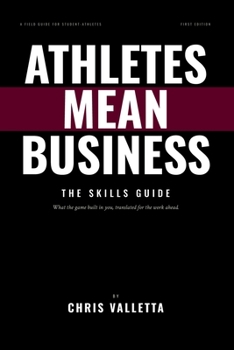
Athletes Mean Business: The Skills Guide

Every athlete is already in business. Some have brand deals today. All of them have built skills employers pay for, whether they start work at 22 or after a career in the pros.
You have run sprints at 6 a.m., watched film of your worst game the next morning, taken hard coaching in front of your teammates, and found a way to win with people you did not choose. Companies build entire training programs trying to teach those skills to new hires. You already have them. What most athletes are missing is the language to prove it.
Every athlete has heard the speech: "only a small percentage of you will go pro, and the ones who do will not stay long." Former Texas A&M and NFL offensive lineman Chris Valletta heard it too, and he hated it. This book is not that speech. It shows you how to put your skills to work now, when a brand wants your name on its product, and later, in your first job or after a long career in the pros.
Athletes Mean Business: The Skills Guide covers twelve college sports and ninety-six skills. Each skill is shown in a real moment in competition and in a specific scene in business, then tagged with the emotional intelligence competency and the leadership competency it proves. Together, the tags cover all twelve competencies in the Goleman and Boyatzis emotional intelligence model and all thirty-eight in the Korn Ferry Leadership Architect, the same language employers use in interview guides and performance reviews.
Inside you will find:
You are already in business: how to run your name like a business, what to check before you sign a deal, who belongs on your team, and how to handle the moneyKnow Your Edge, a self-assessment that shows your strongest skills and the ones to build nextTwelve behavioral interview questions you are likely to hear, each matched to the skills in this guide that answer itThe STAR method, with sample answers built from a sportA resume chapter with before-and-after examples, including how to list your NIL work as real experienceA LinkedIn chapter with a headline formula and a four-sentence About sectionA worksheet to build your own interview answersAs AI takes on more of the technical work, the skills left for people are the ones athletes practice every day: composure, coachability, teamwork, and leading under pressure. This book helps you name those skills and put them to work in the sport of business.
For student-athletes, former athletes starting a career, and the coaches, parents, advisors, and career centers who help them.
Customer Reviews
ThriftBooks ® and the ThriftBooks ® logo are registered trademarks of Thrift Books Global, LLC
