
Skip to content
Scan a barcode
Scan
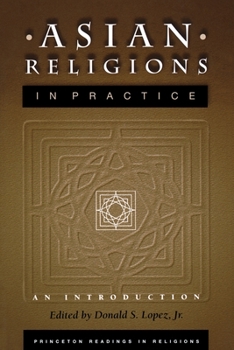
Paperback Asian Religions in Practice: An Introduction Book

ISBN: 0691005133

ISBN13: 9780691005133

Asian Religions in Practice: An Introduction

Select Format

Select Condition ThriftBooks Help Icon

Recommended

Format: Paperback

Condition: Very Good

$6.49
Save $40.51!
List Price $47.00
Only 6 Left
Save to List

Book Overview

Princeton Readings in Religions is a new series of anthologies on the religions of the world, representing the significant advances that have been made in the study of religions in the last thirty years. This volume brings together the introductions to the first five volumes of this acclaimed series: Religions of India in Practice (1995), Buddhism in Practice (1995), Religions of China in Practice (1996), Religions of Tibet in Practice (1997), and Religions of Japan in Practice (1999). The introductions to these volumes have been widely praised for their accessible, clear and concise overviews of the religions of Asia, providing both historical context and insightful analysis of Hinduism, Jainism, Sikhism, Islam, Buddhism, Confucianism, Taoism, Shinto, and Bon, as well as many local traditions. The authors of the chapters are leading scholars of Asian religions: Richard Davis (India), Stephen Teiser (China), George Tanabe (Japan), and Donald Lopez (Buddhism and Tibet). They bring together the best and most current research on their topics, while series editor Donald Lopez provides an introduction to the volume as a whole. In addition to providing a wealth of detail on the history, doctrine, and practice of the religions of Asia, the five chapters offer an opportunity for sustained discussions of the category of "religion."

Customer Reviews

2 ratings

An adequate overview with lingering problems

The following was written as a sort of "after the discussion of the book response" to the professor. Through seeing what responses I had, and the issues I picked up on especially you can gain a better understanding of the book. In general, it's good point is that it covers a lot of ground, and it covers "practice" not "philosophy" or "history". It's low points... the Japan chapter was particularly poorly synthesized, the two chapters by Lopez ignored Korea (and it's major contribution to Buddhism), the typographical errors, and the short length for such a major topic. It's about "Asian" religions, but entirely focused on Indian religions, almost entirely Mahayana Buddhism, no mention of SE Asian religiosity or changes to practices there, no mention of newer religions in for example Vietnam or the interesting interpretation of Islam in Indonesia. To improve, rewrite the Japan chapter, fix the typos, add a chapter on Korea and a chapter on Vietnam, and SE Asian Buddhism and SE Asian Islam. On the other hand, this book is a collection of the introductory essays for five other books, and you can just buy the five and get lots more details, I'm sure. In fact, I felt disappointed by this book. Throughout the book, Lopez, the primary author, neglects the impact of Korea on Buddhism, and the books seems to imply that in Korean religions; in shamanism, Buddhism and Korea's interpretation of Zhu Xi Neo-Confucianism there is nothing new to say, or original or different. The message of the book is that yet again, if you know China and Japan, you've got Korean covered. Perhaps just on an emotional level is makes me angry to no end when Korea is unreasonably ignored, and I felt like a scholar of Lopez's repute should never have done so. Furthermore, as I own his "Buddhism in Practice" and am waiting for the delivery of "Tibetan Religions", I sure hope that his other books exhibit more attention to typographical errors than this one. I find it extremely unprofessional and generally disappointing to find words where letters have been reversed or a letter is missing from the beginning of the word and so on. I found issue with the repeated use of the term "syncretic". Even now, as I check the dictionary definition of the word to see if I am understanding it correctly (Syncretic: Reconciliation or fusion of differing systems of belief, as in philosophy or religion, especially when success is partial or the result is heterogeneous.) I don't like what it says, I don't like the idea of "success is partial or the result is heterogeneous". This means that by calling a religion syncretic you are calling it something less than whole, complete, perfected. Whether you call Sikkhism or Sufism which I have no real emotional attachment to, or Tibetan Buddhism, which I do, syncretic I can't help but find this word coming from a western scholar to be at least slightly derogatory. Though I can certainly see the point in talking about syncretism in the pe

The best textbook out there...

This book surpasses all others currently available in terms of accuracy, subtlety, and complexity-a remarkable achievement, given the vastness of the task. An excellent introduction to Asian religions for college-level students, superbly supplemented by essays in the volumes from which these essays were excerpted.
Copyright © 2026 Thriftbooks.com Terms of Use | Privacy Policy | Do Not Sell/Share My Personal Information | Cookie Policy | Cookie Preferences | Accessibility Statement
ThriftBooks ® and the ThriftBooks ® logo are registered trademarks of Thrift Books Global, LLC

GoDaddy Verified and Secured