


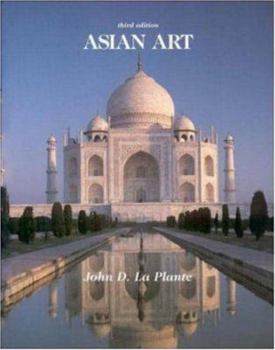
Asian Art


Select Format
Select Condition 
Book Overview
Publisher: McGraw-Hill Humanities/Social Sciences/Languages Published: January 1, 1992 This description may be from another edition of this product.
Format:Paperback
Language:English
ISBN:0697115917
ISBN13:9780697115911
Release Date:January 1992
Publisher:McGraw-Hill Education
Length:304 Pages
Weight:2.34 lbs.
Dimensions:10.8" x 0.8" x 8.4"
Related Subjects
Ancient Art Arts, Music & Photography Asia Buddhism China Education & Reference History & Criticism India JapanCustomer Reviews
4 ratings
Needed for a class...
Published by Thriftbooks.com User , 16 years ago
This was an older edition, but it is good shape and arrived without any issues. The teacher even suggested looking for an older edition to save us money. This fit the bill. Thank you.
Good, but needs some more editing and better visuals
Published by Thriftbooks.com User , 24 years ago
La Plante's text is able to give you a good feel for the artistic culture of India, China, and Japan over the past several millennia, which is an immense task that he does well. This book, however, has pretty disappointing flaws.Reviewers of this book have alrady excoriated it for lousy pictures, and while this does not destroy the book's good value, these complaints are valid. The picture of Mohenjo-Daro's "High Priest" statue is heavily shadowed, and many of the black-and-white photos simply do not do justice to the material. Even if the publisher refused to suck it up and splurge on more color, shots with a better layout and lighting would do wonders.Another gripe is more technical, but could really confuse someone who is not familiar with Chinese names. La Plante, as a preface to his section on China, notes that he uses the Pinyin system of transcribing Chinese sounds into the Roman alphabet. For the most part, yes, he does use Pinyin, but he isn't entirely consistent. The great historian of China, Sima Qian, is spelled "Sima Chien", where "Sima" is in pinyin but "Chien" uses another transcription system. There are several other similar glitches. It's a silly mistake to make, and could throw off a student who is probably already intimidated by Chinese pronunciations. The book does an excellent job of teaching you about different civilizations' artwork, especially considering the immensity of the cultures that are discussed and the relative thinness of the book--I just wish that some of these quirks would get ironed in the next editions, because then this book would really shine.
Excellent Alternative to Sherman Lee
Published by Thriftbooks.com User , 25 years ago
This text offers a basic survey of Asian Art history. Unlike A History of Far Eastern Art, by Sherman Lee, which is disproportionately weighted towards Chinese painting, La Plante is careful to balance between the three major art historical traditions of Asia (India, China, Japan). The author also covers developments in contemporary Asian art, as well as often neglected Islamic traditions in India. unfortunately, the book is not lavishly illustrated, but this is reflected in the reduced price, which makes the book more affordable for many students.
Interesting, but where are the pictures?
Published by Thriftbooks.com User , 25 years ago
La Plante gives a great historical context to the art he describes. This helps to make the subject of Asian Art accessible and alive for the western reader. However, there is a surprising lack of visual images, considering the book's art-related content. And, most of the images are small black-and-whites. There are only a few select color photos. This makes it hard for the reader to fully appreciate and enjoy this subject. The book is organized chronologically by country and covers India, China, and Japan. Painting, architecture, sculpture, and ceramics are the main types of art discussed. La Plante defines obscure terminology at the end of each chapter, which is helpful. Altogether, a fine read for contextual information, best if paired with a good source of visual images of arts from ancient Asia.
Copyright © 2026 Thriftbooks.com Terms of Use
| Privacy Policy | Do Not
Sell/Share My Personal Information | Cookie Policy | Cookie Preferences | Accessibility Statement
ThriftBooks® and the ThriftBooks® logo are registered trademarks of Thrift Books Global, LLC
ThriftBooks® and the ThriftBooks® logo are registered trademarks of Thrift Books Global, LLC
