


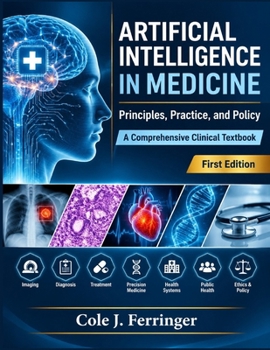
Artificial Intelligence in Medicine: Principles, Practice, and Policy

Medicine Is Changing. Clinical Decisions Are Changing With It.
A radiology system identifies a suspicious lesion on a scan and moves the study to the top of the reporting queue. An electrocardiogram algorithm detects an arrhythmia before the patient reports symptoms. A sepsis prediction model flags a deteriorating patient several hours before conventional clinical recognition. A large language model summarizes a medical record, drafts clinical documentation, or generates a recommendation that a physician must evaluate before acting.
These are no longer simply research questions. They are practical challenges emerging across modern healthcare.
But recognizing a pattern is not the same as making a reliable diagnosis. A model that performs well on a retrospective dataset may fail when introduced into a different hospital, patient population, or clinical workflow. An apparently accurate algorithm may reproduce existing inequalities, generate misleading recommendations, or create new patient-safety risks.
This book is written for those who need to understand not only what artificial intelligence can do in medicine, but also how to evaluate it, implement it, and govern its use responsibly.
From Algorithms to Clinical PracticeAcross 21 chapters organized into five parts, this textbook develops a comprehensive account of artificial intelligence in medicine, progressing from foundational concepts and technical methods to specialty-specific applications, health-system transformation, and responsible implementation.
Coverage includes:
Understanding medical AI: Artificial intelligence, machine learning, deep learning, expert systems, foundation models, clinical AI applications, and the performance metrics used to evaluate them.Working with clinical data: Electronic health records, medical imaging, genomics, wearable devices, health registries, data interoperability, clinical data quality, labeling, privacy, dataset shift, and representativeness.Understanding machine learning and deep learning: Supervised and unsupervised learning, regression, decision trees, ensemble methods, neural networks, convolutional networks, transformers, model training, validation, calibration, and uncertainty.Medical imaging and language technologies: Computer vision, image classification, segmentation, radiomics, image reconstruction, clinical natural language processing, large language models, retrieval-augmented generation, clinical documentation, and hallucination control.Biosignals and precision medicine: ECG, EEG, EMG, digital biomarkers, remote monitoring, genomic sequencing, protein structure prediction, pharmacogenomics, multi-omics integration, and single-cell analysis.AI across clinical specialties: Applications in radiology, pathology, laboratory medicine, cardiology, oncology, ophthalmology, dermatology, neurology, psychiatry, emergency medicine, critical care, surgery, and anesthesia.Drug discovery and population health: Generative chemistry, drug repurposing, toxicity prediction, clinical trial recruitment, pharmacovigilance, disease surveillance, outbreak detection, epidemiological forecasting, and global health applications.Transforming healthcare delivery: Hospital scheduling, resource allocation, supply-chain optimization, clinical decision support, electronic health record integration, telemedicine, virtual care, and the economics of clinical AI.Ethics, regulation, and patient safety: Algorithmic bias, fairness, explainability, accountability, privacy, informed consent, FDA and EU regulatory frameworks, software as a medical device, clinical validation, cybersecurity, and post-market surveillance.Customer Reviews
ThriftBooks ® and the ThriftBooks ® logo are registered trademarks of Thrift Books Global, LLC
