


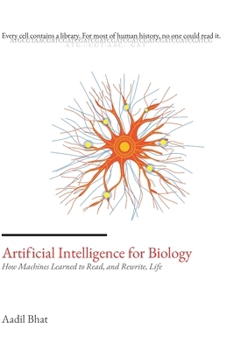
Artificial Intelligence for Biology: How Machines Learned to Read, and Rewrite, Life

For most of human history, the instructions that build a human being were locked inside every cell, unreadable, invisible, and beyond reach. Then, in the space of a few decades, we learned to read them. Now we are beginning to rewrite them.
Artificial Intelligence for Biology tells the story of two scientific revolutions that unfolded at the same time and reshaped one another. One was the rise of artificial intelligence, giving us systems that can see, read, and reason about biological data at a scale no human could match. The other was the transformation of biology itself, bringing technologies that made it possible to sequence genomes, edit DNA, map every cell in the human body, and predict the three-dimensional structures of proteins with remarkable accuracy.
Each chapter begins with a moment of discovery: a competition, a patient, an experiment, or a breakthrough that seemed impossible until it wasn't. From the Human Genome Project to AlphaFold, from CRISPR to single-cell sequencing, and from the first deep learning models to foundation models trained on hundreds of millions of protein sequences, this book traces how machines learned to read life and why learning to write it may become one of the defining scientific developments of the twenty-first century.
Written for curious readers with no prior background in biology or computer science, yet rich enough to reward researchers and practitioners alike, this book offers a clear and engaging guide to one of the fastest-moving frontiers of modern science.
Aadil Rashid Bhat, PhD is a computer scientist and the founder of BioSkillsLab, an online platform dedicated to teaching artificial intelligence and bioinformatics. His work focuses on the intersection of machine learning, genomics, and computational biology, with a particular interest in making advances in AI and biology accessible to students, researchers, and the wider public.
Customer Reviews
ThriftBooks ® and the ThriftBooks ® logo are registered trademarks of Thrift Books Global, LLC
