


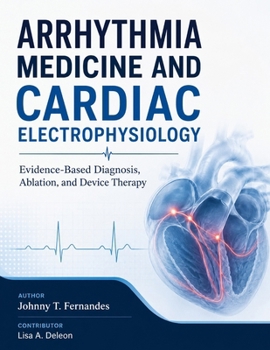
Arrhythmia Medicine and Cardiac Electrophysiology: Evidence-Based Diagnosis, Ablation, and Device Therapy
No Customer Reviews

Master the mechanisms, patterns, and clinical decisions behind complex heart rhythm disorders.
Arrhythmia Medicine and Cardiac Electrophysiology is a comprehensive professional reference that connects foundational electrical science with practical rhythm evaluation and treatment planning. Written for cardiology fellows, practicing cardiologists, internists, emergency physicians, advanced practice providers, and other clinicians, it progresses from conduction-system anatomy and ion-channel physiology to ECG analysis, ambulatory monitoring, invasive studies, electroanatomical mapping, genetic testing, catheter-based interventions, stroke prevention, and sudden cardiac death.
Across fifteen detailed chapters, the text explains how arrhythmias begin, how they are recognized, and how contemporary clinicians integrate surface ECG findings, intracardiac recordings, imaging, risk scores, pharmacology, and procedural strategies. Clear learning objectives, clinical pearls, comparative tables, and visual diagrams support both structured study and point-of-care review.
Rather than treating rhythm disorders as isolated ECG patterns, the book links each presentation to the underlying substrate, trigger, conduction pathway, and hemodynamic consequence. This makes it useful for readers who want to move beyond memorization and develop a coherent framework for evaluating atrial and ventricular rhythm disorders in the clinic, emergency department, intensive care unit, and electrophysiology laboratory.Build a mechanism-based understanding of automaticity, triggered activity, reentry, fibrosis, and electrical remodeling.Interpret narrow- and wide-complex tachycardias using systematic ECG criteria and diagnostic pathways.Compare Holter monitors, event recorders, implantable loop recorders, wearables, and exercise testing.Understand invasive EP measurements, programmed stimulation, pacing maneuvers, and procedural safety principles.Explore high-density mapping, intracardiac echocardiography, cardiac CT, MRI integration, and radiation reduction.Review atrial tachycardia, AVNRT, accessory pathways, atrial flutter, atrial fibrillation, ventricular tachycardia, and ventricular fibrillation.Connect anticoagulation, genetic evaluation, stroke prevention, defibrillator selection, and sudden death risk stratification.Develop a more integrated view of modern rhythm care and strengthen the scientific reasoning behind ECG interpretation, electrophysiology procedures, and individualized clinical decisions.
Arrhythmia Medicine and Cardiac Electrophysiology is a comprehensive professional reference that connects foundational electrical science with practical rhythm evaluation and treatment planning. Written for cardiology fellows, practicing cardiologists, internists, emergency physicians, advanced practice providers, and other clinicians, it progresses from conduction-system anatomy and ion-channel physiology to ECG analysis, ambulatory monitoring, invasive studies, electroanatomical mapping, genetic testing, catheter-based interventions, stroke prevention, and sudden cardiac death.
Across fifteen detailed chapters, the text explains how arrhythmias begin, how they are recognized, and how contemporary clinicians integrate surface ECG findings, intracardiac recordings, imaging, risk scores, pharmacology, and procedural strategies. Clear learning objectives, clinical pearls, comparative tables, and visual diagrams support both structured study and point-of-care review.
Rather than treating rhythm disorders as isolated ECG patterns, the book links each presentation to the underlying substrate, trigger, conduction pathway, and hemodynamic consequence. This makes it useful for readers who want to move beyond memorization and develop a coherent framework for evaluating atrial and ventricular rhythm disorders in the clinic, emergency department, intensive care unit, and electrophysiology laboratory.Build a mechanism-based understanding of automaticity, triggered activity, reentry, fibrosis, and electrical remodeling.Interpret narrow- and wide-complex tachycardias using systematic ECG criteria and diagnostic pathways.Compare Holter monitors, event recorders, implantable loop recorders, wearables, and exercise testing.Understand invasive EP measurements, programmed stimulation, pacing maneuvers, and procedural safety principles.Explore high-density mapping, intracardiac echocardiography, cardiac CT, MRI integration, and radiation reduction.Review atrial tachycardia, AVNRT, accessory pathways, atrial flutter, atrial fibrillation, ventricular tachycardia, and ventricular fibrillation.Connect anticoagulation, genetic evaluation, stroke prevention, defibrillator selection, and sudden death risk stratification.Develop a more integrated view of modern rhythm care and strengthen the scientific reasoning behind ECG interpretation, electrophysiology procedures, and individualized clinical decisions.
Format:Paperback
Language:English
ISBN:B0H8MLGNTL
ISBN13:9798187002887
Release Date:July 2026
Publisher:Independently Published
Length:534 Pages
Weight:2.70 lbs.
Dimensions:1.1" x 8.5" x 11.0"
Customer Reviews
0 rating
Copyright © 2026 Thriftbooks.com
Terms of Use | Privacy Policy | Do Not Sell/Share My Personal Information | Cookie Policy | Cookie Preferences | Accessibility Statement
ThriftBooks ® and the ThriftBooks ® logo are registered trademarks of Thrift Books Global, LLC
ThriftBooks ® and the ThriftBooks ® logo are registered trademarks of Thrift Books Global, LLC
