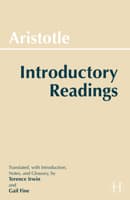
Selections seeks to provide an accurate and readable translation that will allow the reader to follow Aristotle's use of crucial technical terms and to grasp the details of his argument. Unlike anthologies that combine translations by many hands, this volume includes a fully integrated set of translations by a two-person team. The glossary--the most detailed in any edition--explains Aristotle's vocabulary and indicates the correspondences between Greek and English words. Brief notes supply alternative translations and elucidate difficult passages. This description may be from another edition of this product.
All the major works of Aristotle in one convenient book
By Thriftbooks.com User, December 20, 2008
I read this book for a graduate seminar on Aristotle. Irwin and Fine's "Aristotle: Selections," is the best translation of Aristotle's philosophy. We only have lecture notes of Aristotle's works, so no finished texts survive. Aristotle wrote treatises, he wrote to find results and doesn't leave questions unanswered. Aristotle is the first biologist. His way of thinking is scientific. He doesn't use story telling or myth like Plato. Aristotle is a realist, a naturalist, an empiricist. Plato was more of a rational intuitionist. Aristotle believed we were born into a fully real world. We are natural beings. There is no "higher" realm for him, unlike Socrates and Plato. This is also counter to the major religions. Thus, natural life is not a "fallen" condition he is more Greek than Plato is in this regard. The Egyptians influenced Plato and Socrates. Everything Aristotle does begins with what we normally encounter in the world. Thus, our body, and human passions are natural. Aristotle finds that the desire to understand is intrinsic in human beings it is in our nature. Philosophy is the ultimate consequence of desire. Our desires have many aspects; such as, food, sex, etc. Curiosity is natural in humans, we see it especially in small kids, and curiosity comes from within us. Aristotle argues that philosophy caps off curiosity and wonder. Aristotle points out that wonder is an actual disposition. Aporia = "blocking," something is blocking our wondering as a disturbance and then we struggle to break through with wonder to find the answer. Breaking through aporia can't just be forced but must come from things known. Aristotle always begins his inquiries with observing the familiar. The difference between Plato and Aristotle is that Plato's dialogues use aporia but leave unanswered questions; Aristotle argues that if you try hard you can break thru aporia and get at an answer. If you want to study Aristotle, start with this book! Use Jonathan Lear's "Aristotle: The Desire To Understand," which is the best companion work to illuminate Aristotle's philosophy. I recommend that this work is a must for anyone interested in philosophy, ethics, politics, or anyone who wants to have a basis of a "classical" education. For me, Aristotle is the smartest human that walked the planet!