


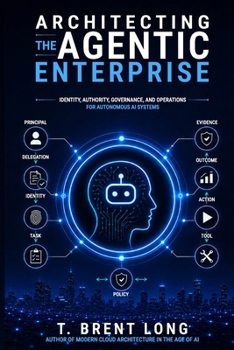
Architecting the Agentic Enterprise: Identity, Authority, Governance, and Operations for Autonomous AI Systems

AI agents are no longer just answering questions. They are beginning to act.
They access protected data, invoke APIs, use enterprise tools, initiate transactions, modify systems, and delegate work to other agents. Once software can create real-world consequences, the architectural problem changes.
The critical question becomes:
Who authorized this agent to do what, using which authority, within what boundaries-and how can the enterprise prove afterward what occurred?
Architecting the Agentic Enterprise provides a practical, vendor-neutral architecture for answering that question.
Written for enterprise, solutions, security, platform, identity, and AI architects-as well as principal engineers and technology leaders-the book treats the AI agent as a delegated actor. Its identity, authority, task, policies, tools, actions, outcomes, and evidence must remain connected throughout execution.
Rather than treating agent security as another prompt-engineering problem, the book examines the enterprise architecture required when probabilistic systems are permitted to exercise consequential authority.
You'll learn how to:
- Distinguish human, workload, agent, and agent-instance identities
- Separate authentication, authorization, delegation, and impersonation
- Issue task-scoped, short-lived authority instead of broad standing privileges
- Apply least privilege to probabilistic actors
- Establish enforceable boundaries around tools, APIs, data, and transactions
- Place deterministic policy enforcement around probabilistic decisions
- Control agent-to-agent delegation and prevent privilege amplification
- Apply MCP authorization within enterprise tool boundaries
- Design meaningful human approval and risk-tiered autonomy
- Limit blast radius through transaction, rate, resource, and authority constraints
- Interrupt, revoke, contain, and recover autonomous execution
- Build decision traces and evidence chains that support reconstruction and accountability
- Evaluate agents before expanding their production authority
- Govern an enterprise portfolio of autonomous and semi-autonomous actors
- Apply a vendor-neutral reference architecture for delegated agency
The architecture is organized around a simple but demanding chain:
Principal → Delegation → Agent Identity → Task → Policy → Tool → Action → Outcome → Evidence
Each chapter translates the architecture into practical design guidance through an Architect's Takeaway, Authority Checklist, and Decision Checklist, giving readers concrete questions and criteria they can apply during architecture reviews and production-readiness decisions.
Architecting the Agentic Enterprise is not an introductory AI book, programming tutorial, IAM textbook, or generic responsible-AI framework. It is an architecture book for experienced technologists confronting a new enterprise reality: software that can reason about what to do next-and then do it.
Maximum autonomy is not the objective. Appropriate autonomy is.
Customer Reviews
ThriftBooks ® and the ThriftBooks ® logo are registered trademarks of Thrift Books Global, LLC
