


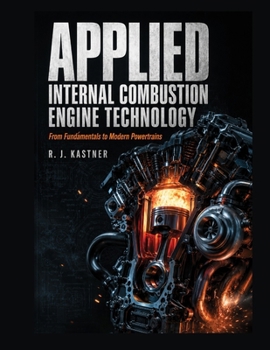
Applied Internal Combustion Engine Technology: From Fundamentals to Modern Powertrains
No Customer Reviews

An engineer who can integrate an Otto-cycle pressure-volume diagram can often still not explain why a modern turbocharged, direct-injected engine needs a particulate filter, a knock sensor, and a hybrid control strategy working together to meet today's performance, efficiency, and emissions targets at the same time.
That gap is a familiar frustration for engineering students and early-career engineers alike. Thermodynamics coursework builds a rigorous foundation in air-standard cycles, but it rarely connects that foundation to the combustion chemistry, mechanical loading, emissions aftertreatment, and electronic control systems that actually govern a production engine. Meanwhile, many design-oriented references assume the cycle analysis is already second nature and move straight to hardware, and readers are often left assembling their understanding from several separate, differently-notated texts: one for cycles, another for combustion, another for mechanical design, another for emissions, another for hybrid systems.
This applied engineering guide closes that gap with a single, internally consistent treatment of the internal combustion engine across sixteen chapters, following the engine's own subsystems in the order a design engineer actually encounters them, from first-principles thermodynamic cycles through combustion physics, fuel chemistry, induction and boosting, mechanical design, electronic control, and hybrid or electrified powertrain integration, closing with a case-studies chapter that applies every prior chapter's methods to real, production-representative engine architectures.
With this book, you will be able to: Trace one consistent thermodynamic and mechanical framework across cycle analysis, combustion, fuels, induction, mechanical design, electronics, and hybridizationPractice calculating indicated and brake mean effective pressure, and volumetric and mechanical efficiency, from realistic engine dataWork through spark-ignition and compression-ignition combustion fundamentals, including knock, ignition delay, and multiple-injection strategiesSize fuel injectors, evaluate turbocharger matching, and quantify intercooling benefits using the book's derivation-based approachCalculate mechanical loads on valvetrain, piston, connecting-rod, and crankshaft components, including fatigue-life estimation and vibration controlEvaluate emissions-control trade-offs among charge dilution, catalytic reduction, and particulate-filtration strategiesApply the entire framework to three detailed, cross-referenced case studies covering a boosted direct-injection engine, a heavy-duty diesel with layered aftertreatment, and a hybrid-integrated Atkinson-cycle engineWritten for upper-level undergraduate and graduate mechanical or automotive engineering students who have completed an introductory thermodynamics sequence, for instructors seeking a single-course reference connecting theory to design, and for early-career and practicing engineers in automotive, truck, marine, stationary-power, and powertrain-design roles.
Take the next step toward a single, dependable applied understanding of the internal combustion engine, from fundamentals to modern powertrains, structured as a lasting reference for study and for practice.
That gap is a familiar frustration for engineering students and early-career engineers alike. Thermodynamics coursework builds a rigorous foundation in air-standard cycles, but it rarely connects that foundation to the combustion chemistry, mechanical loading, emissions aftertreatment, and electronic control systems that actually govern a production engine. Meanwhile, many design-oriented references assume the cycle analysis is already second nature and move straight to hardware, and readers are often left assembling their understanding from several separate, differently-notated texts: one for cycles, another for combustion, another for mechanical design, another for emissions, another for hybrid systems.
This applied engineering guide closes that gap with a single, internally consistent treatment of the internal combustion engine across sixteen chapters, following the engine's own subsystems in the order a design engineer actually encounters them, from first-principles thermodynamic cycles through combustion physics, fuel chemistry, induction and boosting, mechanical design, electronic control, and hybrid or electrified powertrain integration, closing with a case-studies chapter that applies every prior chapter's methods to real, production-representative engine architectures.
With this book, you will be able to: Trace one consistent thermodynamic and mechanical framework across cycle analysis, combustion, fuels, induction, mechanical design, electronics, and hybridizationPractice calculating indicated and brake mean effective pressure, and volumetric and mechanical efficiency, from realistic engine dataWork through spark-ignition and compression-ignition combustion fundamentals, including knock, ignition delay, and multiple-injection strategiesSize fuel injectors, evaluate turbocharger matching, and quantify intercooling benefits using the book's derivation-based approachCalculate mechanical loads on valvetrain, piston, connecting-rod, and crankshaft components, including fatigue-life estimation and vibration controlEvaluate emissions-control trade-offs among charge dilution, catalytic reduction, and particulate-filtration strategiesApply the entire framework to three detailed, cross-referenced case studies covering a boosted direct-injection engine, a heavy-duty diesel with layered aftertreatment, and a hybrid-integrated Atkinson-cycle engineWritten for upper-level undergraduate and graduate mechanical or automotive engineering students who have completed an introductory thermodynamics sequence, for instructors seeking a single-course reference connecting theory to design, and for early-career and practicing engineers in automotive, truck, marine, stationary-power, and powertrain-design roles.
Take the next step toward a single, dependable applied understanding of the internal combustion engine, from fundamentals to modern powertrains, structured as a lasting reference for study and for practice.
Format:Paperback
Language:English
ISBN:B0HBX9JSGB
ISBN13:9798189544330
Release Date:July 2026
Publisher:Independently Published
Length:242 Pages
Weight:1.26 lbs.
Dimensions:0.5" x 8.5" x 11.0"
Related Subjects
TransportationCustomer Reviews
0 rating
Copyright © 2026 Thriftbooks.com
Terms of Use | Privacy Policy | Do Not Sell/Share My Personal Information | Cookie Policy | Cookie Preferences | Accessibility Statement
ThriftBooks ® and the ThriftBooks ® logo are registered trademarks of Thrift Books Global, LLC
ThriftBooks ® and the ThriftBooks ® logo are registered trademarks of Thrift Books Global, LLC
