


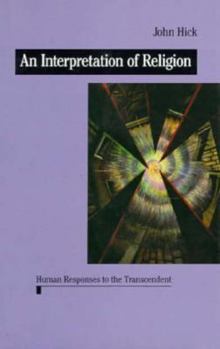
An Interpretation of Religion: Human Responses to the Transcendent


Select Format
Select Condition 
Book Overview
1989 This description may be from another edition of this product.
Format:Hardcover
Language:English
ISBN:0300042485
ISBN13:9780300042481
Release Date:September 1989
Publisher:Yale University Press
Length:427 Pages
Weight:2.20 lbs.
Dimensions:8.8" x 1.0" x 5.8"
Customer Reviews
1 rating
A philosophical consideration of religious pluralism
Published by Thriftbooks.com User , 25 years ago
John Hick, perhaps best known as the editor of the infamous _The Myth of God Incarnate_, here undertakes a massive task: providing a philosophical justification for religious pluralism.I'm surprised to see that it hasn't been reviewed yet, because I think it's one of his best books. But then again, it's also one of his thickest and most demanding.Essentially, his thesis is that all human religions are (as his subtitle indicates) human responses to a transcendent reality which (or Who) "has many names," as another of his book titles puts it. On this view, the measure of a religion's "success" is its ability to move people along the path of salvation/liberation/call it what you will.Now, there are tremendous difficulties with this view, and Hick does not duck them; that's one reason the book is so thick. I won't try to summarize his arguments here; readers who want shorter and more accessible discussions can turn to one of his other books for a good introduction. At any rate he sorts carefully through a bewildering array of "responses to the transcendent" and tries, mostly successfully, to sort them into some sort of pattern despite their occasional apparent contradictions of one another. (At bottom he relies on a Kantian distinction between the noumenal and the phenomenal to argue for the existence of a single transcendent Reality not exhausted in human conceptions thereof.)What I find most interesting about his attempt is that the outcome is very close to the view of mainstream Judaism. Judaism has never claimed to be a universal religion; on the traditional Jewish view, all people (and peoples) have their own particular spiritual strengths and weaknesses, with the Jews in this sense being only one people among others. Nor are all of the mitzvot (commandments) universal and "objective" in the full sense: there is not, for example, anything inherently unclean about pork; it's just that Jews are forbidden to eat it. (Breaking the kosher laws is "malum prohibitum," not "malo in se." Certain foods are said to be "unclean for you," not unclean in themselves.)Moreover, Judaism's major philosophers have long held that God "in Himself," the Ein Sof, is not directly knowable (at least through anything short of mystical insight) although His "attributes" may be. Here again, some people (and peoples) are better equipped than others to deal with this or that particular attribute, but no one party or group has the full scoop; the arrangement is one of interdependence, not of everybody-follow-the-leader.So whatever disagreements I may have with this or that point in Hick's massive work, I agree wholeheartedly with the spirit of it and recommend it to any reader interested in the nature and purpose of "religion." There is a real, deep problem as to whether a religious believer can acknowledge the existence and even "validity" (a much overused word) of other faiths without simply folding them into one's own. Hick tackles the question with great intellectual vigo
Copyright © 2026 Thriftbooks.com
Terms of Use | Privacy Policy | Do Not Sell/Share My Personal Information | Cookie Policy | Cookie Preferences | Accessibility Statement
ThriftBooks ® and the ThriftBooks ® logo are registered trademarks of Thrift Books Global, LLC
ThriftBooks ® and the ThriftBooks ® logo are registered trademarks of Thrift Books Global, LLC
