


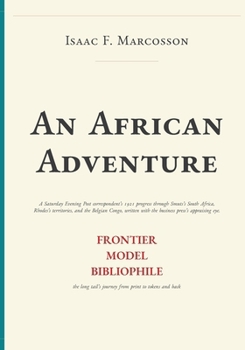
An African Adventure
No Customer Reviews

In 1920 the American journalist Isaac F. Marcosson set out from London on a four-month traverse of southern and central Africa, beginning with a long interview of Jan Smuts at Groote Schuur and ending at Banana Point where the Congo meets the Atlantic. Between those points he rode the Cape-to-Cairo line up through Rhodesia, descended into the diamond pits at Premier Mine, crossed into the Belgian Katanga, and steamed two thousand miles down the Lualaba and Congo on the Comte de Flandre. The result, serialized first in the Saturday Evening Post and gathered here in 1921, is a portrait of European colonial Africa at the moment of its post-Versailles reorganization, written by a man whose trade was the close-range study of statesmen, capitalists, and industrial enterprises. The voice is recognizably American, recognizably commercial, and unmistakably of its decade. The apparatus added to this facsimile sets the book in the literature it grew out of and the literature it would help provoke. An African Adventure is a 1921 first-person narrative of a journey undertaken in 1920 by Isaac Frederick Marcosson, then one of the highest-paid magazine correspondents in the United States and a fixture of the Saturday Evening Post. Six chapters trace a single arc: an interview with Prime Minister Jan Smuts at Groote Schuur; a passage north up the Cape-to-Cairo line; the Rhodesias under Chartered Company rule; the industrial Katanga; the long descent of the Lualaba and Congo by stern-wheel steamer; and a closing chapter on the American Presbyterian mission stations and the American capital that had recently established itself in the Belgian colony. The book is short for its territory, fewer than three hundred pages of narrative, and it makes no pretense to ethnography or expedition science. It is a working journalist's report on what he saw, whom he met, and what enterprises were moving. The pieces appeared first as a sequence of articles in the Saturday Evening Post under George Horace Lorimer's editorship, and the book retains the rhythm of the magazine: each chapter is a self-contained dispatch, organized around a central figure or industry rather than around a stretch of map. The world it came from was the immediate aftermath of the Paris Peace Conference. The German African colonies had been redistributed under League of Nations mandates only the previous year. Smuts, who had drafted much of the mandate framework, was simultaneously consolidating the Union of South Africa against a Nationalist resurgence; Marcosson opens with him because Smuts in 1920 was, to the American business press, the single most legible figure on the African continent. The Belgian Congo, which occupies four of the six chapters, was barely a decade out from Leopold's personal ownership and had become, by 1920, a state-run extractive enterprise whose copper and diamond output was beginning to interest American syndicates. Marcosson's introduction to the Congo came through Thomas Fortune Ryan, the New York financier whose Formini re concession is the engine behind the book's final chapter. The dedication is to Ryan; the framing is American capital looking at African opportunity. The author's stance toward the colonial enterprise is admiring and unconflicted; he writes from inside the administrative network, riding the company trains, sleeping in the company rest-houses, dining with the resident commissioners, and his sympathies are with the men he describes. For a present-day reader the book is most useful as a primary document of three things at once. The first is the American business press's eye on the colonial enterprise: admiring of order, impatient with what it took to be inefficiency, attentive above all to capitalization, throughput, and labor supply. The second is the texture of physical travel through a continent before the airplane.
Format:Paperback
Language:English
ISBN:B0HF3Z78FC
ISBN13:9798259506848
Release Date:February 2027
Publisher:Frontier Model Bibliophile
Length:378 Pages
Weight:1.44 lbs.
Dimensions:0.8" x 7.0" x 10.0"
Related Subjects
TravelCustomer Reviews
0 rating
Copyright © 2026 Thriftbooks.com
Terms of Use | Privacy Policy | Do Not Sell/Share My Personal Information | Cookie Policy | Cookie Preferences | Accessibility Statement
ThriftBooks ® and the ThriftBooks ® logo are registered trademarks of Thrift Books Global, LLC
ThriftBooks ® and the ThriftBooks ® logo are registered trademarks of Thrift Books Global, LLC
