


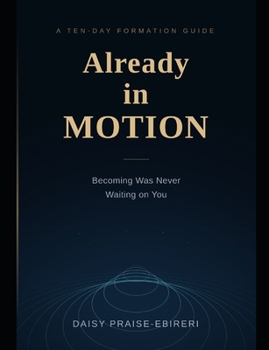
Already in Motion: Becoming Was Never Waiting on You
No Customer Reviews

You are watching someone reach for their phone.
Not dramatically. Nothing about the moment asks to be noticed. A lull in conversation, a silence that goes on a beat too long, and there it is-the hand already moving before the mind has caught up to give permission. You've seen a parent do this. A stranger on a train. Maybe a sibling, mid-sentence, reaching without seeming to know they're reaching.
And then, without quite choosing to, you notice your own hand has done the same thing more times this week than you could count if asked.
That's the part that's easy to miss the first time it happens-that recognizing something in someone else can be the moment you finally see it in yourself. Not because you were blind before. Because the pattern was running quietly enough, automatically enough, that it never asked to be examined. You didn't decide, at some clear point, to become a person who reaches for distraction before discomfort. It simply became how you move through certain moments, the way water finds the lowest point in a landscape without ever once being asked to.
Try, now, to remember when it started. Not the phone specifically-whatever your own version is. The habit of speech you didn't choose. The flinch you inherited without meaning to. The thing you do automatically now that you know, somewhere underneath, you didn't always do.
You probably can't locate it. Most people can't. There's no morning you woke up and selected it. There's only the difference between who you were and who you are, and a long, unmarked stretch of ordinary days somewhere in between where the difference was being built, one small repetition at a time, without your supervision.
This is the part nobody tells you about becoming someone: it doesn't wait for your permission to begin. It also doesn't announce itself when it does. You are not handed a moment of clarity in which your formation is offered to you for approval. It is already underway, in the unremarkable texture of an ordinary Tuesday, long before you have the language to notice it happening at all.
This book is about that fact, and what it asks of you once you've actually seen it.
A few pages in, I want to tell you plainly what path this book takes, because I'd rather you know it now than discover it with any sense of having been led somewhere you didn't agree to go. This book moves through Scripture. Every day of it. Not as decoration, and not as proof of anything-as the actual method, the lens this particular exploration of becoming is conducted through. I think that's true and useful whether or not you currently consider yourself a person of faith, and I want to say plainly why, rather than assume you'll take it on faith yourself.
Scripture, read the way this book reads it, is not a set of answers handed down from a distance. It's an unusually honest record of people in the middle of becoming-failing, waiting, obeying before they understood why, building character in rooms no one else was watching. Joseph doesn't get a dramatic conversion scene. He gets a confusing situation and a choice made quietly, in the dark, with no audience and no certainty. Paul doesn't arrive at the truth about grace through a tidy argument-he arrives at it by way of his own well-documented failure to live up to what he already knew. These are not abstractions. They are some of the most carefully observed accounts of formation that exist, and they happen to be the ones I know best, the ones I have spent these years actually living inside rather than simply reading. I'm not asking you to agree with everything in these pages theologically before you're allowed to begin. I'm asking you to let the method do its work, the way you'd let a piece of music do its work whether or not you'd composed it yourself.
Not dramatically. Nothing about the moment asks to be noticed. A lull in conversation, a silence that goes on a beat too long, and there it is-the hand already moving before the mind has caught up to give permission. You've seen a parent do this. A stranger on a train. Maybe a sibling, mid-sentence, reaching without seeming to know they're reaching.
And then, without quite choosing to, you notice your own hand has done the same thing more times this week than you could count if asked.
That's the part that's easy to miss the first time it happens-that recognizing something in someone else can be the moment you finally see it in yourself. Not because you were blind before. Because the pattern was running quietly enough, automatically enough, that it never asked to be examined. You didn't decide, at some clear point, to become a person who reaches for distraction before discomfort. It simply became how you move through certain moments, the way water finds the lowest point in a landscape without ever once being asked to.
Try, now, to remember when it started. Not the phone specifically-whatever your own version is. The habit of speech you didn't choose. The flinch you inherited without meaning to. The thing you do automatically now that you know, somewhere underneath, you didn't always do.
You probably can't locate it. Most people can't. There's no morning you woke up and selected it. There's only the difference between who you were and who you are, and a long, unmarked stretch of ordinary days somewhere in between where the difference was being built, one small repetition at a time, without your supervision.
This is the part nobody tells you about becoming someone: it doesn't wait for your permission to begin. It also doesn't announce itself when it does. You are not handed a moment of clarity in which your formation is offered to you for approval. It is already underway, in the unremarkable texture of an ordinary Tuesday, long before you have the language to notice it happening at all.
This book is about that fact, and what it asks of you once you've actually seen it.
A few pages in, I want to tell you plainly what path this book takes, because I'd rather you know it now than discover it with any sense of having been led somewhere you didn't agree to go. This book moves through Scripture. Every day of it. Not as decoration, and not as proof of anything-as the actual method, the lens this particular exploration of becoming is conducted through. I think that's true and useful whether or not you currently consider yourself a person of faith, and I want to say plainly why, rather than assume you'll take it on faith yourself.
Scripture, read the way this book reads it, is not a set of answers handed down from a distance. It's an unusually honest record of people in the middle of becoming-failing, waiting, obeying before they understood why, building character in rooms no one else was watching. Joseph doesn't get a dramatic conversion scene. He gets a confusing situation and a choice made quietly, in the dark, with no audience and no certainty. Paul doesn't arrive at the truth about grace through a tidy argument-he arrives at it by way of his own well-documented failure to live up to what he already knew. These are not abstractions. They are some of the most carefully observed accounts of formation that exist, and they happen to be the ones I know best, the ones I have spent these years actually living inside rather than simply reading. I'm not asking you to agree with everything in these pages theologically before you're allowed to begin. I'm asking you to let the method do its work, the way you'd let a piece of music do its work whether or not you'd composed it yourself.
Format:Paperback
Language:English
ISBN:B0H6VRLS8L
ISBN13:9798184364032
Release Date:June 2026
Publisher:Independently Published
Length:140 Pages
Weight:0.58 lbs.
Dimensions:0.3" x 7.4" x 9.7"
Customer Reviews
0 rating
Copyright © 2026 Thriftbooks.com
Terms of Use | Privacy Policy | Do Not Sell/Share My Personal Information | Cookie Policy | Cookie Preferences | Accessibility Statement
ThriftBooks ® and the ThriftBooks ® logo are registered trademarks of Thrift Books Global, LLC
ThriftBooks ® and the ThriftBooks ® logo are registered trademarks of Thrift Books Global, LLC
