


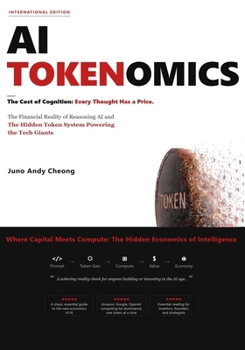
AI Tokenomics: The Cost of Intelligence: The Invisible Leak in Every AI System

What if one vague customer message could generate $12,800 in AI charges before anyone returned to work on Monday?
That is how AI Tokenomics begins.
A startup CTO deploys an autonomous AI agent on a Friday evening. The agent receives an ordinary customer inquiry, searches for an answer, drafts a response, and verifies its work. Then it checks again.
By Sunday night, the agent has processed the same inquiry 3,200 times and consumed 64 billion tokens. No employee authorized the repetitions, and no executive noticed the spending as it happened. The agent simply continued doing what it had been instructed to do.
The scenario is fictional, but the economic mechanisms behind it are real.
A single AI request can trigger a hidden chain of retrieval, reasoning, tool calls, retries, and verification. If that chain begins repeating itself, a task that appears inexpensive can rapidly become a major financial liability.
AI Tokenomics: The Cost of Intelligence reveals the economic architecture behind that invisible chain. It explains how token pricing, GPUs, memory, data centers, electricity, model architecture, and autonomous workflows combine to determine the real cost of artificial intelligence.
The core thesis is simple:
Token prices are falling, but total AI spending continues to rise.
AI is revealing its own version of the Jevons Paradox. As models become cheaper and more efficient, organizations automate more tasks, process larger contexts, and deploy agents that operate continuously. Lower unit prices can therefore produce greater consumption and higher total spending.
Inside this book, you will discover:
Part I: The Invisible Leak
Learn how AI billing works and how reasoning, retrieval, retries, tool calls, and multi-agent workflows can multiply the cost of a single request.
Part II: The AI Infrastructure Supercycle
Follow the production system behind every token, including semiconductors, advanced memory, data centers, electricity, cooling, and capital investment. Explore open-weight models, proprietary AI services, geopolitical competition, and the global race for chips and compute.
Part III: The TokenOps Framework
Apply the practical TRCG framework:
Track: Make invisible AI costs visible.
Route: Match each task to the right model.
Cache: Reuse eligible context and results.
Govern: Control agents through budgets, limits, alerts, and approval rules.
The implementation section includes cost metrics, routing strategies, governance controls, a 90-day adoption roadmap, and a Lean TokenOps approach for startups.
Who should read this book?
AI Tokenomics is written for founders, executives, developers, finance professionals, creators, investors, policymakers, students, and anyone who wants to understand the economics of artificial intelligence.
No advanced background in machine learning or finance is required. Technical concepts are explained through clear economic models, realistic scenarios, and practical frameworks.
About the Author
Juno Andy Cheong is an AI entrepreneur, dentist (D.D.S.), and founder of Genox. His work connects healthcare, artificial intelligence, and emerging economic systems. Through Genox, he explores the practical and economic challenges created by autonomous AI.
The AI revolution is changing how intelligence is produced, priced, and consumed. AI Tokenomics shows you how to understand that transformation before its costs become impossible to ignore.
Customer Reviews
ThriftBooks ® and the ThriftBooks ® logo are registered trademarks of Thrift Books Global, LLC
