


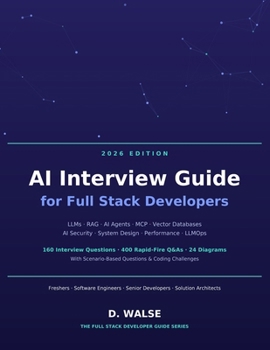
AI Interview Guide for Full Stack Developers: AI Interview Preparation for Full Stack Developers

The Full Stack Developer Guide Series - D. Walse
AI questions are now in every full stack interview. This book is how you answer them.
In 2026, you can't get through a technical loop without being asked how an LLM actually works, how you'd design a RAG pipeline, how you'd stop prompt injection, or how you use AI coding assistants day to day. This is a complete, interview-focused preparation guide for developers at every level - from freshers facing their first screening round to senior engineers and architects walking into system design panels.
What's inside
160 in-depth interview questions and answers across 16 chapters, organized by difficulty (Beginner, Intermediate, Advanced), with the most commonly asked questions clearly flagged400 rapid-fire Q&As - 25 per chapter - for fast revision the night before24 professional diagrams covering the transformer, the RAG pipeline, the agent loop, MCP architecture, HNSW search, prompt injection paths, and production AI system designCoding challenges and system design walkthroughs, including a tool-calling loop, a semantic cache, a token-budget conversation manager, an AI coding assistant backend, and an enterprise document-Q&A platformA 30-day preparation plan, a final readiness checklist, and a 73-term glossaryEvery answer follows the same battle-tested structure: a complete spoken answer, key points, a worked example, follow-up questions the interviewer will actually ask next, common mistakes that sink candidates, and a panel tip on how to deliver it.
The 16 chapters
AI Fundamentals - Large Language Models - Prompt Engineering - AI Coding Assistants - AI for Frontend - AI for Backend - AI Agents - Model Context Protocol (MCP) - RAG - Vector Databases & Embeddings - AI APIs & Integration - AI Security - AI System Design - AI Performance - AI Deployment & LLMOps - Interview Scenarios & Coding Challenges
Current for 2026
This edition covers what interviewers are asking now: reasoning models and test-time compute, agentic coding tools, the Model Context Protocol, GraphRAG and query transformation, the OWASP LLM Top 10, excessive agency, denial-of-wallet attacks, slopsquatting, evaluation-driven development, LoRA fine-tuning, prefill vs. decode, continuous batching, and treating cost as a first-class design constraint.
Written for how interviews are actually won
This isn't a machine learning textbook, and it isn't a list of trivia. It teaches you to reason out loud like a senior engineer: lead with requirements, name the trade-off, pair every risk with a mitigation, and know when not to use a technique. It's honest about limits - where AI-generated code fails, when RAG beats fine-tuning, why guardrails belong in code and not the prompt, and why calibrated honesty beats bluffing in the room.
Practical, current, and built entirely around what gets asked.
Customer Reviews
ThriftBooks ® and the ThriftBooks ® logo are registered trademarks of Thrift Books Global, LLC
