


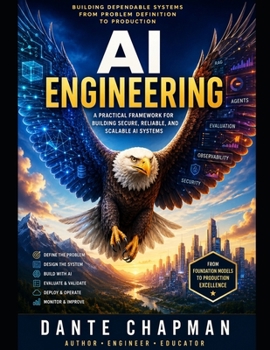
AI Engineering: Building Dependable Systems from Problem Definition to Production

By Dante Chapman
Artificial intelligence delivers remarkable demonstrations in minutes. Production systems demand far more. They must protect data, enforce permissions, control costs, survive dependency failures, expose uncertainty, support human oversight, and remain measurable after deployment.
AI Engineering presents a complete systems-engineering framework for transforming foundation models into dependable applications. Dante Chapman moves beyond prompt tricks and model rankings to explain the architecture, controls, evaluations, workflows, and operational disciplines that determine whether an AI product succeeds in real-world conditions.
The book begins with a central principle: start with the problem, not the model. Readers learn to define measurable outcomes, map user workflows, establish operational boundaries, classify risk, separate deterministic rules from probabilistic inference, and select the least uncertain architecture that completes the task.
The technical foundation covers model behavior, tokenization, embeddings, sampling, structured output, data quality, provenance, evaluation, prompt and context engineering, production retrieval-augmented generation, memory, fine-tuning, multimodal interaction, and real-time systems. Each concept connects directly to production decisions instead of remaining an isolated theory.
The book then advances into workflow orchestration, tool-using AI, agent architecture, multi-agent coordination, autonomy levels, production infrastructure, delivery pipelines, inference optimization, cloud-native deployment, observability, and cost engineering. Security, reliability, governance, human approval, runtime assurance, rollback, incident response, and safe degradation remain integrated throughout the engineering lifecycle.
Three complete capstone systems turn the material into applied architecture:
A secure enterprise knowledge assistantA bounded operations agentA multimodal business workflowCustomer Reviews
ThriftBooks ® and the ThriftBooks ® logo are registered trademarks of Thrift Books Global, LLC
