


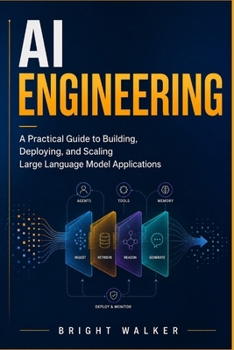
AI Engineering: A Practical Guide to Building, Deploying, and Scaling Large Language Model Applications

AI Engineering: A Practical Guide to Building, Deploying, and Scaling Large Language Model Applications
Every team building with LLMs eventually hits the same wall: the demo works, and production doesn't.
Prompts that performed beautifully in testing start failing on real user input. RAG pipelines return confidently wrong answers. Agents loop forever, burning tokens on a task they should have solved in three steps. And nobody on the team can say, with actual evidence, whether last week's change made things better or worse.
AI Engineering is the book for the engineer who has already shipped the prototype and is now facing the harder problem: making it reliable.
This isn't another high-level overview of what LLMs are or a tour of the latest frameworks. It's a hands-on, code-first guide to the actual engineering discipline of building AI-powered systems that hold up under real users, real data, and real failure conditions - written for developers, ML practitioners, and technical leads who need to go from "it works on my machine" to "it works in production."
Inside, you'll learn how to:
Engineer prompts as versioned, tested artifacts - not string literals you tweak and hopeBuild retrieval-augmented generation pipelines that actually retrieve the right information, with chunking strategies, hybrid search, and re-ranking that go beyond naive tutorialsDesign and bound AI agents so they take real actions safely, without runaway loops or unchecked behaviorBuild evaluation harnesses that measure quality with statistical rigor, so you know a change is actually an improvement - not noiseLayer guardrails, fallback strategies, and circuit breakers so your system degrades gracefully instead of failing silentlyDeploy AI systems with the caching, streaming, and async architecture that model-call latency actually demandsMonitor cost, quality drift, and reliability continuously, so problems surface before your users find them for youWritten for practitioners, not spectators. Every chapter pairs clear conceptual grounding with complete, working Python code - using LangChain, LangGraph, and production-grade patterns - plus the reasoning behind every design decision, so you understand why it works, not just how to copy it.
Whether you're a software engineer moving into AI for the first time, an ML practitioner building your first production LLM system, or a technical lead trying to separate real engineering practice from hype, this book gives you a durable way of thinking that outlasts any single tool or framework version.
The models will keep changing. The discipline won't.
Customer Reviews
ThriftBooks ® and the ThriftBooks ® logo are registered trademarks of Thrift Books Global, LLC
