


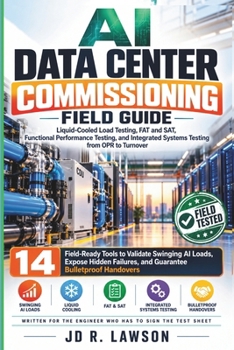
AI Data Center Commissioning Field Guide: Liquid-Cooled Load Testing, FAT and SAT, Functional Performance Testing, and Integrated Systems Testing from
No Customer Reviews

The load won't sit still. The test sheet still needs your signature. An AI hall doesn't run at the number on the drawing. It swings by tens of percent in under a second, over and over, and every pump, valve and control loop in the cooling plant has to ride that swing without help. Most commissioning scripts were written for a load that holds steady. They pass halls that struggle the first we You know how that story ends. The test was green. The signature was real. And somebody still got a call at 3 a.m. because the plant did something nobody had tested. This is the commissioning field guide for liquid-cooled AI halls, written from beside the test for the engineer who has to call pass, fail or retest while the load keeps moving. Other books explain the lifecycle or hand you blank forms. This one covers the verdict. What you'll be able to doRead an owner's project requirements document and find the test it forgot Write a factory witness list for a CDU before the unit ships Run day-zero checks on site before anyone calls it ready Accept a liquid loop on measured numbers, not run hours Test the plant at the bottom of its range, where it actually misbehaves Verify the power chain, control points and every sequence in every modeProve redundancy by taking things away, one failure at a time Run an integrated systems test that records what the utility will ask for Handle a failed test without hiding it, then hand the owner a measured baseline instead of a binderFourteen chapters, fourteen toolsThe chapters follow the job in the order it happens. Each one ends with a tool you can use on the next project, and a knowledge check with an answer key: The load that won't sit still: Load Swing Profile - Write the test before you pour the concrete: OPR Gap MatrixThe plan nobody reads: No-Skip RegisterFly to the factory: Factory Witness ScriptDay zero on site: Loop Acceptance ScorecardThe plant at the bottom of its range: Turndown DrillThe CDU handshake: Boundary CharterThe power chain under test: Ride-Through CensusGreen on the screen isn't proof: Forced-Point QuotaEvery sequence, every mode: Mode ManifestBreak one thing at a time: Single-Failure SlatePull the plug: IST PacketWhen the test fails: Fix-or-Redesign RulingThe day the owner takes the keys: Handover DossierOne worked 20 MW hall runs through the whole book, so every number connects to the next. You also get 18 figures, a glossary, and one sourced Resources page where every figure traces to a named document. Why it's different
It teaches the verdict, not just the procedure. You'll learn how to decide when a result is a pass, when it's a retest, and when the design has to change. Every number traces to a named source, because one wrong formula in a technical book costs the author a reader's trust for good. Who it's for
Commissioning agents, mechanical and electrical engineers, controls specialists, contractors, owner's reps and facility leads who stand at the test table and decide. If you already know what a CDU and a chiller do, this picks up where the basics stop. Written by someone who was there
The author is a licensed mechanical engineer with more than 25 years in HVAC across three countries. He has stood beside functional tests, CDU startup, power-chain tests and integrated systems testing, and he writes what he watched happen, not what the brochure promised. The pen is heavier than it looks. Read this before you pick it up.
Format:Paperback
Language:English
ISBN:B0HNHQG5HZ
ISBN13:9798163491827
Release Date:October 2026
Publisher:Independently Published
Length:364 Pages
Weight:0.97 lbs.
Dimensions:0.9" x 6.0" x 9.0"
Customer Reviews
0 rating
Copyright © 2026 Thriftbooks.com
Terms of Use | Privacy Policy | Do Not Sell/Share My Personal Information | Cookie Notice | Cookie Preferences | Accessibility Statement
ThriftBooks ® and the ThriftBooks ® logo are registered trademarks of Thrift Books Global, LLC
ThriftBooks ® and the ThriftBooks ® logo are registered trademarks of Thrift Books Global, LLC
