


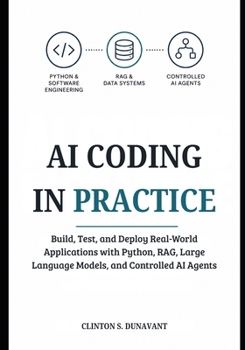
AI Coding in Practice: Build, Test, and Deploy Real-World Applications with Python, RAG, Large Language Models, and Controlled AI Agents

Building an impressive AI demo is easy. Building an AI application that remains accurate, secure, testable, and dependable under real-world conditions is much harder.
You may already know Python or have experimented with large language models, yet still struggle to move beyond basic prompts, fragile chatbots, and disconnected code samples. Model outputs can be malformed. Retrieval can surface irrelevant or unauthorized information. Tool calls can repeat destructive actions. Agent loops can exceed their limits, lose state, or fail without explaining what happened.
Without a disciplined engineering process, promising prototypes remain difficult to test, deploy, monitor, and trust.
SolutionAI Coding in Practice provides a hands-on path for Python developers, software engineers, technical founders, and AI practitioners who want to build complete, production-oriented AI applications-not isolated demonstrations.
Through a continuing AI Support Operations Assistant project, you will learn how to combine conventional software engineering with large language models, retrieval-augmented generation, typed tool calling, durable state, human approval, security controls, observability, and deployment.
The book helps you:
Build a reproducible Python workspace with FastAPI, PostgreSQL, Docker, uv, testing tools, and structured configuration.Create evidence-grounded RAG pipelines using document ingestion, chunking, embeddings, keyword search, semantic retrieval, reranking, metadata filters, and traceable citations.Design provider-neutral model gateways with structured outputs, prompt versioning, retries, fallbacks, token limits, cost budgets, and offline tests.Implement controlled AI agents with typed tools, approval gates, idempotency, checkpoints, stop conditions, recovery procedures, and verified completion.Test, secure, observe, containerize, deploy, monitor, and safely improve the complete application.The guidance moves step by step from environment setup and architecture through implementation, evaluation, security, CI pipelines, release monitoring, and rollback planning.
ProofThe book follows the practical PRACTICE Framework: Plan the application, Reproduce the environment, Access models through contracts, Connect trusted knowledge and tools, Test deterministic behavior, Inspect probabilistic quality, Control agent actions, and Execute and evolve in production.
Its twelve chapters build one connected system rather than presenting unrelated tutorials. The project includes typed APIs, database migrations, hybrid retrieval, citation validation, tool-risk levels, human approval, agent recovery, adversarial evaluation, tenant isolation, tracing, containerization, health checks, deployment controls, and release-readiness procedures. Reusable code patterns, engineering frameworks, handoff records, incident checklists, and a production definition of done extend the material beyond the core build.
By completing the book, you can gain a repeatable method for turning AI capabilities into software that is bounded, observable, recoverable, and accountable.
Customer Reviews
ThriftBooks ® and the ThriftBooks ® logo are registered trademarks of Thrift Books Global, LLC
