


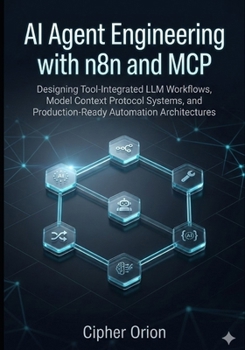
AI Agent Engineering with n8n and MCP: Designing Tool-Integrated LLM Workflows, Model Context Protocol Systems, and Production-Ready Automation Archit
No Customer Reviews

The Automation Layer Is Evolving, Most Systems Are Not Ready
AI agents are rapidly moving from experimental demos to production infrastructure. Organizations are integrating large language models into operational workflows, building automated decision systems, and connecting AI directly to APIs, databases, and enterprise tools. Yet most implementations fail under real-world conditions. Workflows break when tools return unexpected outputs. Context is lost between executions. Multi-step processes produce inconsistent results. Scaling exposes reliability gaps. Observability is missing. And few engineers design agents with production architecture in mind. The result: fragile automation. This book addresses the gap between prototype AI agents and production-grade automation systems. From Workflow Automation to Intelligent Agent Infrastructure
n8n has emerged as one of the most powerful open-source workflow orchestration platforms available today. At the same time, Model Context Protocol (MCP) introduces a standardized framework for tool exposure, context management, and capability routing in LLM-driven systems. When properly engineered together, they form a powerful foundation for: Tool-integrated LLM agentsContext-aware automation workflowsMulti-agent task coordinationAPI-driven intelligent systemsScalable AI infrastructureBut building reliable AI agents requires more than connecting nodes in a visual editor. It demands architectural thinking.
This book provides a systems-engineering approach to designing, orchestrating, and deploying AI agents using n8n and MCP with a focus on reliability, memory management, tool-calling frameworks, and production deployment. What This Book Delivers
This is not a beginner tutorial.
It is a technical engineering guide for building resilient AI automation systems.
Inside, you will learn how to: Design modular AI agent architectures using n8n as an orchestration engineImplement Model Context Protocol (MCP) for standardized tool integrationEngineer tool-calling pipelines with structured validation layersBuild context management systems for persistent and session-based memoryDevelop multi-agent coordination patterns for complex workflowsHandle failure modes in tool execution and LLM reasoningIntroduce observability and logging into AI workflowsImplement retry, fallback, and guardrail mechanismsDeploy AI agents in production environments with scalable infrastructureSecure agent systems with access control and governance controlsOptimize latency, cost, and throughput in automation pipelinesStructure enterprise-ready AI automation architecturesEach chapter builds progressively from foundational architecture principles to advanced deployment strategies. Designed for Technical Practitioners
This book is written for: Automation engineers building AI-enabled workflowsBackend developers integrating LLMs with APIsAI consultants designing intelligent process automationTechnical founders deploying AI-driven systemsDevOps engineers responsible for production AI workflowsIt assumes familiarity with: APIs and RESTful systemsBasic LLM conceptsWorkflow automation platformsJSON and structured dataNo prior MCP experience is required; it is covered in depth. Who This Book Is Not For
This book is not: A no-code beginner tutorialA motivational guide to AI entrepreneurshipA generic prompt engineering handbookA hype-driven exploration of AI trendsIt is a technical manual focused on engineering discipline and practical deployment.
AI agents are rapidly moving from experimental demos to production infrastructure. Organizations are integrating large language models into operational workflows, building automated decision systems, and connecting AI directly to APIs, databases, and enterprise tools. Yet most implementations fail under real-world conditions. Workflows break when tools return unexpected outputs. Context is lost between executions. Multi-step processes produce inconsistent results. Scaling exposes reliability gaps. Observability is missing. And few engineers design agents with production architecture in mind. The result: fragile automation. This book addresses the gap between prototype AI agents and production-grade automation systems. From Workflow Automation to Intelligent Agent Infrastructure
n8n has emerged as one of the most powerful open-source workflow orchestration platforms available today. At the same time, Model Context Protocol (MCP) introduces a standardized framework for tool exposure, context management, and capability routing in LLM-driven systems. When properly engineered together, they form a powerful foundation for: Tool-integrated LLM agentsContext-aware automation workflowsMulti-agent task coordinationAPI-driven intelligent systemsScalable AI infrastructureBut building reliable AI agents requires more than connecting nodes in a visual editor. It demands architectural thinking.
This book provides a systems-engineering approach to designing, orchestrating, and deploying AI agents using n8n and MCP with a focus on reliability, memory management, tool-calling frameworks, and production deployment. What This Book Delivers
This is not a beginner tutorial.
It is a technical engineering guide for building resilient AI automation systems.
Inside, you will learn how to: Design modular AI agent architectures using n8n as an orchestration engineImplement Model Context Protocol (MCP) for standardized tool integrationEngineer tool-calling pipelines with structured validation layersBuild context management systems for persistent and session-based memoryDevelop multi-agent coordination patterns for complex workflowsHandle failure modes in tool execution and LLM reasoningIntroduce observability and logging into AI workflowsImplement retry, fallback, and guardrail mechanismsDeploy AI agents in production environments with scalable infrastructureSecure agent systems with access control and governance controlsOptimize latency, cost, and throughput in automation pipelinesStructure enterprise-ready AI automation architecturesEach chapter builds progressively from foundational architecture principles to advanced deployment strategies. Designed for Technical Practitioners
This book is written for: Automation engineers building AI-enabled workflowsBackend developers integrating LLMs with APIsAI consultants designing intelligent process automationTechnical founders deploying AI-driven systemsDevOps engineers responsible for production AI workflowsIt assumes familiarity with: APIs and RESTful systemsBasic LLM conceptsWorkflow automation platformsJSON and structured dataNo prior MCP experience is required; it is covered in depth. Who This Book Is Not For
This book is not: A no-code beginner tutorialA motivational guide to AI entrepreneurshipA generic prompt engineering handbookA hype-driven exploration of AI trendsIt is a technical manual focused on engineering discipline and practical deployment.
Format:Paperback
Language:English
ISBN:B0GQSQ2ZFT
ISBN13:9798250309486
Release Date:March 2026
Publisher:Independently Published
Length:152 Pages
Weight:0.61 lbs.
Dimensions:0.3" x 7.0" x 10.0"
Customer Reviews
0 rating
Copyright © 2026 Thriftbooks.com
Terms of Use | Privacy Policy | Do Not Sell/Share My Personal Information | Cookie Policy | Cookie Preferences | Accessibility Statement
ThriftBooks ® and the ThriftBooks ® logo are registered trademarks of Thrift Books Global, LLC
ThriftBooks ® and the ThriftBooks ® logo are registered trademarks of Thrift Books Global, LLC
