


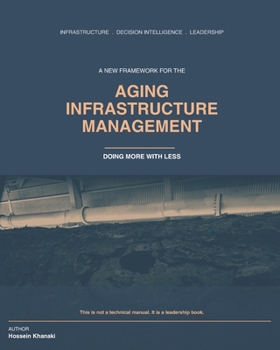
AGING INFRASTRUCTURE MANAGEMENT

The world's critical infrastructure is aging fast, and the data describing its condition is exploding - inspection reports, sensor feeds, photos, legacy records - faster than most organisations can turn it into decisions. The result is a decision gap: the systematic failure to see, prioritise, and act on aging-asset risk with clarity, evidence, and discipline.
Drawing on two decades on the frontline of mining, oil & gas, energy, utilities, and transport, Hossein argues that aging infrastructure is not primarily an engineering problem - it's a decision problem. Most assets in service today were built for a world of stable, predictable deterioration. They have now entered a different phase: non-linear decline, where defects interact, risk accelerates, and yesterday's maintenance playbook no longer applies.
Aging Infrastructure Management gives leaders a practical, evidence-based system for navigating that shift:
How to understand the organisational and cultural factors in aging infrastructure managementHow to address the biases and the psychology of deferralHow to model risk propagation - forecasting how defects and deterioration compound over time, instead of relying on a single inspection snapshotWhy the cost of deferral is rarely linear - a $200K fix delayed can become a $2M repair, a $20M outage, or a $200M incident, and how to see that "capital cliff" comingHow to apply ALARP (As Low As Reasonably Practicable) as a quantifiable decision threshold rather than a subjective judgement callHow to achieve maximum risk reduction per dollar spent through bundling and prioritisation, not just bigger budgetsHow to pursue targeted, evidence-based life extension as a capital-efficient alternative to expensive like-for-like replacementHow to build optimum capital allocation across competing assets, using a single source of truth instead of ad hoc negotiation between engineering, finance, and operationsHow to build an Intelligent Decision Engine for Aging Infrastructure Management to enable transferring raw inspection data into capital decision supportThese ideas are grounded in real case studies, including a $850M+ FPSO decommissioning triggered by deferred risk, an overhead crane replacement programme cut to under 5% of its original $15M budget once condition was properly assessed, and an $800M shutdown overrun caused by proceeding despite readiness red flags.
This is not a technical manual. It is a leadership book - for the executives, asset owners, and engineers who decide what happens to the assets the world already has, and who need a system for turning exploding inspection data into capital-efficient, defensible decisions.
This is not just a technical book. It is a leadership book.Customer Reviews
ThriftBooks ® and the ThriftBooks ® logo are registered trademarks of Thrift Books Global, LLC
