


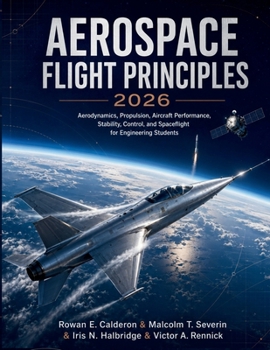
Aerospace Flight Principles 2026: Aerodynamics, Propulsion, Aircraft Performance, Stability, Control, and Spaceflight for Engineering Students

How does an aircraft generate lift, remain stable, climb efficiently, and respond to a pilot or control system? What changes when a vehicle accelerates beyond the atmosphere and enters launch, orbital, and reentry flight?
AEROSPACE FLIGHT PRINCIPLES 2026 FULL-COLOR EDITION] presents a connected introduction to the science and engineering of aircraft and spacecraft. Rather than treating aerodynamics, propulsion, performance, stability, and astronautics as isolated subjects, it shows how these disciplines interact throughout a complete aerospace mission.
The book begins with forces, moments, reference frames, atmospheric properties, dimensional analysis, and conservation laws. It then develops the physical foundations of fluid motion, lift, drag, aerodynamic moments, airfoil behavior, finite wings, high-lift systems, and compressible flow.
From there, readers progress into:
Piston, propeller, gas-turbine, ramjet, rocket, electric, and hybrid propulsion conceptsTakeoff, climb, cruise, descent, landing, range, endurance, and maneuver analysisStatic and dynamic stability, trim, aircraft response modes, and handling qualitiesMechanical, hydraulic, and fly-by-wire control systemsSensors, guidance, navigation, and automatic flight controlRocket thrust, staging, ascent, and launch-vehicle integrationOrbital elements, trajectory changes, rendezvous, escape, and mission planningSpacecraft subsystems, atmospheric entry, hypersonic flight, and reusable vehicles
Worked engineering examples identify assumptions before calculations are performed and interpret what each result means for an actual vehicle. Design-consequence discussions connect equations to configuration choices, while technical tables and figures reinforce the relationship between physical behavior and analytical models.
The eighteen-chapter structure follows a deliberate progression from introductory mechanics to integrated atmospheric and space missions. More than ninety technical figures support the major teaching points, and the appendices provide atmosphere data, unit conversions, notation, reference relationships, orbital constants, and essential aerospace terminology.
AEROSPACE FLIGHT PRINCIPLES 2026 is written for first- and second-year aerospace, aeronautical, and mechanical engineering students. It is also suitable for aviation students, instructors, early-career technical professionals, technically inclined pilots, and independent readers seeking a rigorous but accessible foundation in how aircraft and spacecraft fly.
From the first pressure difference across an airfoil to the final correction of an orbital trajectory, this book develops the analytical habits and physical understanding needed to think about flight as an integrated engineered system.
Related Subjects
Engineering Science Science & Math Science & Scientists Science & Technology TechnologyCustomer Reviews
ThriftBooks ® and the ThriftBooks ® logo are registered trademarks of Thrift Books Global, LLC
