


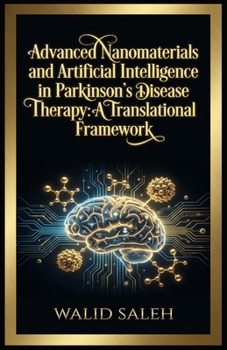
Advanced Nanomaterials and Artificial Intelligence in Parkinson's Disease Therapy: A Translational Framework
No Customer Reviews

Revolutionizing Parkinson's Disease Treatment Through Cutting-Edge Science
Parkinson's Disease affects millions worldwide, yet current treatments remain limited to symptom management rather than disease modification. This groundbreaking work presents a revolutionary approach that merges advanced nanomaterials with artificial intelligence to overcome the most formidable barrier in neurotherapeutics: the Blood-Brain Barrier.
What Makes This Book Essential:
Written for researchers, clinicians, biomedical engineers, and graduate students in neuroscience and materials science, this comprehensive guide explores the convergence of two transformative technologies-Metal-Organic Frameworks (MOFs) and Covalent Organic Frameworks (COFs) paired with AI-driven precision medicine.
Inside This Translational Framework:
The Parkinson's Challenge: Understanding the pathophysiology, current therapeutic limitations, and why conventional drug delivery fails
Material Hardware: Deep dive into MOF and COF structures, synthesis methods, and biomedical properties tailored for brain delivery
Engineering BBB Penetration: Sophisticated strategies for surface modification, receptor-mediated transcytosis, and targeting mechanisms
Advanced Cargo Delivery: Beyond levodopa-delivering genes, proteins, siRNA, CRISPR systems, and therapeutic enzymes directly to affected neurons
Biosafety & Biodegradability: Critical assessment of toxicity profiles, immune responses, and metabolic pathways
Intelligent Software: How machine learning optimizes materials design, predicts host-guest interactions, and enables personalized treatment
AI-Enabled Diagnostics: Digital biomarkers, wearable sensors, and closed-loop therapeutic systems for precision medicine
Clinical Translation: Regulatory pathways, clinical trial design, and the roadmap from laboratory to patient bedside
The Material Hardware + Intelligent Software Paradigm:
This book introduces a unified framework where porous nanomaterials serve as intelligent delivery vehicles while AI algorithms guide design, optimize dosing, and personalize therapy. Learn how stimulus-responsive frameworks release drugs only at disease sites, how neutrophil membrane camouflage enables brain targeting, and how digital twins predict individual patient responses.
Key Features:
- 9 comprehensive chapters with extensive references - Detailed synthesis protocols and characterization methods - Real-world case studies and preclinical evidence - Ethical considerations and global health perspectives - Future horizons: quantum computing, brain-machine interfaces, and disease interception strategies
Who Should Read This Book: Neuroscientists and neurologists seeking novel therapeutic approachesMaterials scientists exploring biomedical applicationsAI/ML researchers in healthcarePharmaceutical scientists and drug delivery specialistsGraduate students in bioengineering, nanotechnology, or neuroscienceHealthcare policymakers and regulatory professionalsTransform Your Understanding of Neurotherapeutics
This is not merely an incremental improvement-it represents a paradigm shift from reactive symptom management to proactive, precision-guided disease modification. Discover how the convergence of nanotechnology and artificial intelligence is dismantling the barriers to effective Parkinson's treatment and paving the way for therapies that may one day intercept neurodegeneration before symptoms appear.
134 pages of cutting-edge research translated into actionable knowledge for the future of neuromedicine.
Parkinson's Disease affects millions worldwide, yet current treatments remain limited to symptom management rather than disease modification. This groundbreaking work presents a revolutionary approach that merges advanced nanomaterials with artificial intelligence to overcome the most formidable barrier in neurotherapeutics: the Blood-Brain Barrier.
What Makes This Book Essential:
Written for researchers, clinicians, biomedical engineers, and graduate students in neuroscience and materials science, this comprehensive guide explores the convergence of two transformative technologies-Metal-Organic Frameworks (MOFs) and Covalent Organic Frameworks (COFs) paired with AI-driven precision medicine.
Inside This Translational Framework:
The Parkinson's Challenge: Understanding the pathophysiology, current therapeutic limitations, and why conventional drug delivery fails
Material Hardware: Deep dive into MOF and COF structures, synthesis methods, and biomedical properties tailored for brain delivery
Engineering BBB Penetration: Sophisticated strategies for surface modification, receptor-mediated transcytosis, and targeting mechanisms
Advanced Cargo Delivery: Beyond levodopa-delivering genes, proteins, siRNA, CRISPR systems, and therapeutic enzymes directly to affected neurons
Biosafety & Biodegradability: Critical assessment of toxicity profiles, immune responses, and metabolic pathways
Intelligent Software: How machine learning optimizes materials design, predicts host-guest interactions, and enables personalized treatment
AI-Enabled Diagnostics: Digital biomarkers, wearable sensors, and closed-loop therapeutic systems for precision medicine
Clinical Translation: Regulatory pathways, clinical trial design, and the roadmap from laboratory to patient bedside
The Material Hardware + Intelligent Software Paradigm:
This book introduces a unified framework where porous nanomaterials serve as intelligent delivery vehicles while AI algorithms guide design, optimize dosing, and personalize therapy. Learn how stimulus-responsive frameworks release drugs only at disease sites, how neutrophil membrane camouflage enables brain targeting, and how digital twins predict individual patient responses.
Key Features:
- 9 comprehensive chapters with extensive references - Detailed synthesis protocols and characterization methods - Real-world case studies and preclinical evidence - Ethical considerations and global health perspectives - Future horizons: quantum computing, brain-machine interfaces, and disease interception strategies
Who Should Read This Book: Neuroscientists and neurologists seeking novel therapeutic approachesMaterials scientists exploring biomedical applicationsAI/ML researchers in healthcarePharmaceutical scientists and drug delivery specialistsGraduate students in bioengineering, nanotechnology, or neuroscienceHealthcare policymakers and regulatory professionalsTransform Your Understanding of Neurotherapeutics
This is not merely an incremental improvement-it represents a paradigm shift from reactive symptom management to proactive, precision-guided disease modification. Discover how the convergence of nanotechnology and artificial intelligence is dismantling the barriers to effective Parkinson's treatment and paving the way for therapies that may one day intercept neurodegeneration before symptoms appear.
134 pages of cutting-edge research translated into actionable knowledge for the future of neuromedicine.
Format:Paperback
Language:English
ISBN:B0GMJTP7C2
ISBN13:9798247557821
Release Date:February 2026
Publisher:Independently Published
Length:136 Pages
Weight:0.36 lbs.
Dimensions:0.3" x 5.5" x 8.5"
Customer Reviews
0 rating
Copyright © 2026 Thriftbooks.com
Terms of Use | Privacy Policy | Do Not Sell/Share My Personal Information | Cookie Notice | Cookie Preferences | Accessibility Statement
ThriftBooks ® and the ThriftBooks ® logo are registered trademarks of Thrift Books Global, LLC
ThriftBooks ® and the ThriftBooks ® logo are registered trademarks of Thrift Books Global, LLC
