


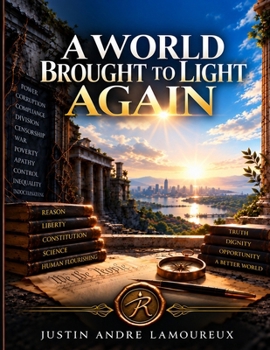
A World Brought To Light Again
No Customer Reviews

What if political power never had to be surrendered to those who govern? A World Brought to Light Again answers with a complete political and economic constitution: forty-four articles, printed in full. To build it, the book brings together constitutional law, political philosophy, economics, history, institutional design, and formal modeling, because the question cuts across all of them. Wealth can buy a voice in writing the rules. Officials respond to incentives like anyone else, so what an institution rewards is what it gets. A body that reviews only itself answers to no one. Technology that can watch citizens can audit power instead. A right is worth only the remedy behind it. Because these are linked, the book offers no list of reforms. It begins with what government is for, treats each inherited form, from a permanent legislature to money that doubles as power, as a design choice, and builds a single system in their place. In its design, political power stays with the people, exercised together. There is no standing legislature. Anyone may propose a law; temporary expert panels draft it and dissolve; auditors are rewarded for finding defects, educators for accuracy, not outcomes. Nothing binds until the people ratify it with sixty percent participation and sixty percent approval. No official is elected or appointed. Each role goes to the most qualified willing person, and every two years to whoever is then most qualified. Temporary Justice Panels hear petitions anyone may bring, so every right carries a remedy. Artificial intelligence audits public power and may never make law or choose its own successor. New emergency powers require a public vote and lapse unless the people renew them. Shelter, food, health care, and education are guaranteed unconditionally. Contribution, including parenting and caregiving, earns a personal claim on discretionary goods and experiences in proportion to its verified value; the claim cannot be sold, inherited, invested, or used to buy a vote or an office. Productive resources go to purpose and capability rather than wealth, so that success can be rewarded without becoming power over others. The book makes the case for markets in its strongest form, then tests the present economy and its own design alike against standards drawn from Friedman, Hayek, Coase, Schumpeter, and other defenders and analysts of markets. Seventeen formal models, from a stock-flow model of debt to state machines for lawmaking and emergencies, make its assumptions explicit, so a weakness shows up on paper before it shows up in anyone's life. More than four hundred endnotes carry its sources; history serves as evidence, from Athens restraining its guardians to Pennsylvania's 1776 rule that public bills be printed for the people. One ordinary Tuesday in a city living under the proposal shows its effects before their causes, and the final part works through the transition, from mortgages to armed forces. For years Justin Andre Lamoureux has fought to restore his relationship with his son through institutions that promised remedies and did not deliver them. That experience led him to a larger question: what if the problem is not only the people who exercise power, but an architecture that concentrates it? The World Peoples Union is a proposal, not a government, and would exist only where a people chose it, territory by territory, by voluntary ratification. Its Constitution is printed whole, so you never have to take the author's word for what it says. Examine it. Challenge it. Stress-test it. Improve it.
Format:Paperback
Language:English
ISBN:B0HMPKZRX9
ISBN13:9798174346130
Release Date:October 2026
Publisher:Independently Published
Length:548 Pages
Weight:2.76 lbs.
Dimensions:1.1" x 8.5" x 11.0"
Customer Reviews
0 rating
Copyright © 2026 Thriftbooks.com
Terms of Use | Privacy Policy | Do Not Sell/Share My Personal Information | Cookie Notice | Cookie Preferences | Accessibility Statement
ThriftBooks ® and the ThriftBooks ® logo are registered trademarks of Thrift Books Global, LLC
ThriftBooks ® and the ThriftBooks ® logo are registered trademarks of Thrift Books Global, LLC
